La liste d'épicerie ultime classée par allée — modèle gratuit
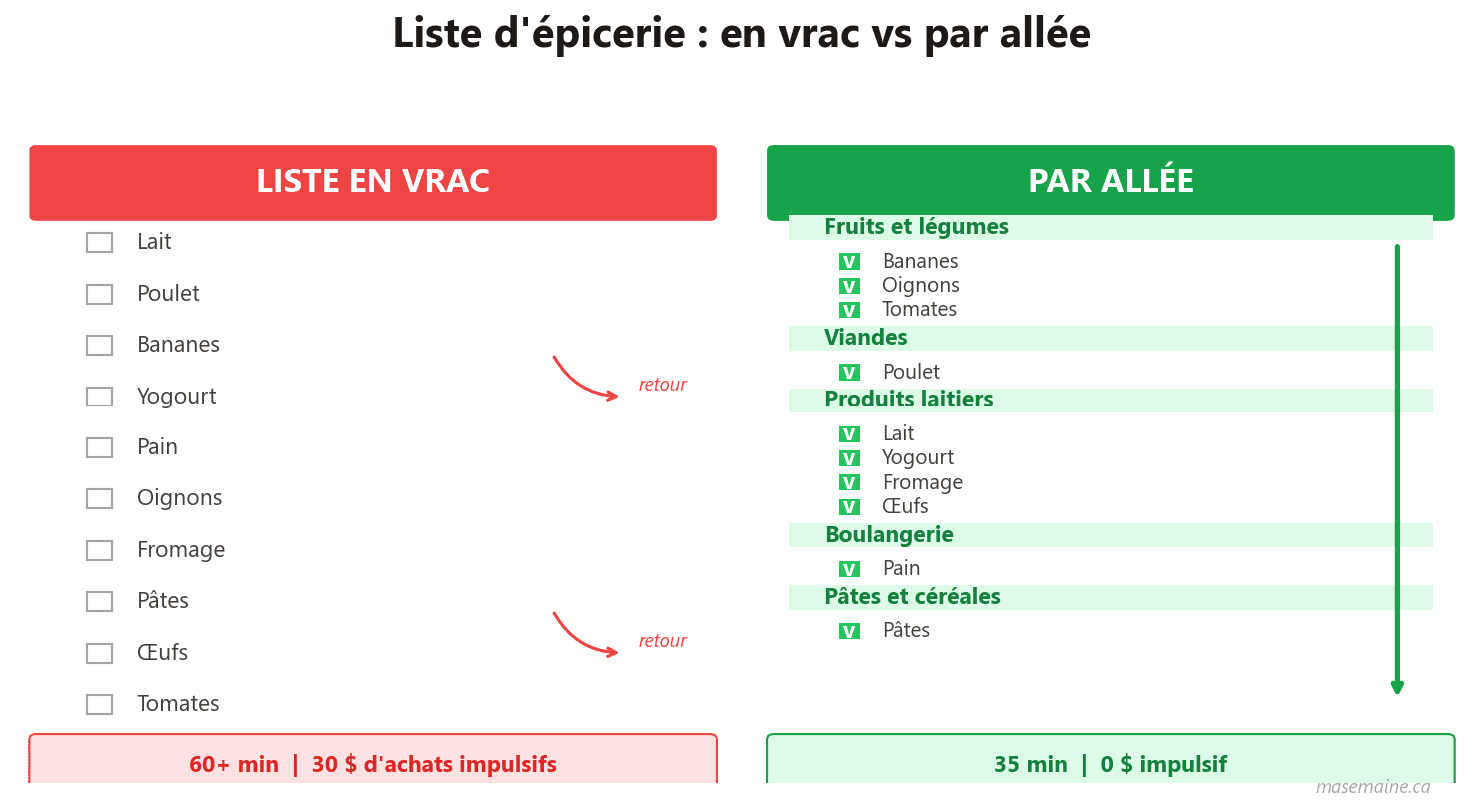
Une liste d'épicerie bien organisée, c'est l'un des outils les plus simples qui change véritablement la façon dont on fait ses courses. Les études montrent que les gens qui magasinent avec une liste dépensent environ 23 % de moins que ceux qui se promènent dans les allées sans plan [1]. Mais toutes les listes ne se valent pas — une liste en vrac sur votre téléphone, ça veut encore dire zigzaguer d'un bout à l'autre du magasin, revenir sur vos pas et perdre bien plus de temps que nécessaire.
La solution est simple : organiser votre liste par allée, selon la disposition réelle du magasin. Un seul passage à travers l'épicerie, pas de retour en arrière, rien d'oublié. Ça sauve 15 à 20 minutes par visite [2], et sur une année, ça représente plus d'une journée complète de récupérée.
En un coup d'œil : liste en vrac vs liste par allée
La plupart des gens écrivent leur liste dans l'ordre où les items leur viennent en tête. Voici ce que ça donne en magasin :
Maintenant, la même épicerie avec une liste organisée par allée :
Pourquoi organiser sa liste par allée?
Une liste organisée par allée reproduit la disposition physique du magasin. On commence à une extrémité et on avance section par section :
- Pas de retour en arrière. On visite chaque section une seule fois.
- Rien n'est oublié. Quand on consulte la section correspondante de sa liste dans la bonne allée, on attrape tout.
- Des décisions plus rapides. On ne perd pas de temps à chercher mentalement quoi prendre — c'est déjà trié.
- Moins d'achats impulsifs. Moins d'errance signifie moins de dépenses non planifiées. Les recherches estiment que 60 % des achats non planifiés sont déclenchés simplement par l'exposition aux produits en magasin [3].
La majorité des épiceries au Québec — Maxi, IGA, Metro, Super C, Provigo, Walmart — suivent une disposition remarquablement similaire. Les fruits et légumes sont près de l'entrée, la boulangerie et le comptoir de charcuterie sur le pourtour, les surgelés au fond ou dans les allées centrales. Le modèle ci-dessous fonctionne dans pratiquement toutes ces enseignes.
Le modèle complet de liste d'épicerie
Utilisez ce modèle comme point de départ. Cochez ce dont vous avez besoin chaque semaine, sautez le reste. Les sections suivent la disposition typique du magasin, de l'entrée à la caisse.
Fruits et légumes (section des produits frais)
- Bananes
- Pommes
- Oranges ou clémentines
- Petits fruits (fraises, bleuets)
- Citrons ou limes
- Laitue ou mélange à salade
- Tomates
- Concombres
- Carottes
- Oignons
- Pommes de terre
- Poivrons
Viandes et poissons (comptoir de la boucherie)
- Poitrines ou cuisses de poulet
- Boeuf haché
- Côtelettes ou filet de porc
- Filets de saumon
- Saucisses
- Bacon
- Charcuteries (jambon, dinde)
- Crevettes
- Cubes de boeuf à ragoût
- Tofu
Produits laitiers et oeufs
- Lait
- Beurre
- Oeufs (douzaine)
- Fromage cheddar
- Fromage mozzarella
- Yogourt (nature ou grec)
- Fromage à la crème
- Crème sûre
- Crème 35 %
- Parmesan
Pain et boulangerie
- Pain tranché
- Baguette
- Tortillas ou wraps
- Muffins anglais
- Pains à hamburger ou à hot dog
- Pains pita
- Croissants
- Bagels
Surgelés
- Légumes surgelés (pois, maïs, mélange)
- Fruits surgelés (pour smoothies)
- Pizza surgelée
- Crème glacée
- Filets de poisson surgelés
- Frites
- Petits fruits congelés
- Repas préparés surgelés
- Pâtes à tarte
- Jus concentré congelé
Conserves et sauces
- Tomates en conserve (en dés, broyées)
- Pâte de tomate
- Légumineuses en conserve (noires, pois chiches, rouges)
- Thon en conserve
- Bouillon de poulet ou de légumes
- Sauce pour pâtes
- Sauce soya
- Huile d'olive
- Vinaigre (blanc, balsamique)
- Maïs en conserve
Pâtes, riz et céréales
- Spaghetti ou penne
- Riz (blanc, brun, basmati)
- Quinoa
- Couscous
- Gruau (flocons d'avoine)
- Farine tout usage
- Chapelure
- Nouilles aux oeufs
- Lasagnes
Épices, condiments et cuisson
- Sel et poivre
- Ail (frais ou en poudre)
- Cumin
- Paprika
- Origan séché
- Cannelle
- Moutarde (Dijon, jaune)
- Ketchup
- Mayonnaise
- Miel
Collations et céréales à déjeuner
- Céréales à déjeuner
- Barres tendres
- Craquelins
- Croustilles
- Maïs soufflé
- Noix (amandes, arachides)
- Fruits séchés
- Biscuits
- Beurre d'arachide
- Mélange du randonneur
Boissons
- Café (moulu ou en grains)
- Thé
- Jus (orange, pomme)
- Eau pétillante
- Boissons gazeuses
- Laits végétaux (avoine, amande)
- Boissons sportives
- Eau (caisse)
Entretien ménager
- Savon à vaisselle
- Détergent à lessive
- Nettoyant tout usage
- Essuie-tout
- Papier de toilette
- Sacs à ordures
- Papier d'aluminium
- Pellicule plastique
- Éponges
- Savon à mains
Comment adapter ce modèle à votre épicerie
Le modèle ci-dessus couvre la majorité des épiceries québécoises, mais chaque succursale a ses particularités. Voici comment le personnaliser :
- Faites un tour de votre magasin avec attention. Notez l'ordre des départements de l'entrée à la sortie. Réordonnez les sections du modèle en conséquence.
- Ajoutez vos incontournables. Si votre famille consomme un produit spécifique chaque semaine (une marque de yogourt, une farine spéciale), ajoutez-le de façon permanente dans la bonne section.
- Retirez ce que vous n'achetez jamais. Une liste plus courte et plus propre se consulte plus vite. Si vous n'achetez jamais de boissons sportives, enlevez-les.
- Notez les numéros d'allée. Certaines personnes ajoutent le numéro d'allée à côté de chaque section. C'est particulièrement utile quand quelqu'un d'autre fait l'épicerie à votre place.
Liste papier ou application?
Les deux fonctionnent. Le bon choix dépend de votre façon de magasiner.
La liste papier est idéale si vous aimez cocher physiquement les items, si la batterie de votre téléphone a tendance à lâcher en plein magasinage, ou si vous partagez la liste en la collant sur le frigo pour que la famille y ajoute des items durant la semaine.
La liste numérique brille quand on veut réutiliser la même base chaque semaine, trier automatiquement ou partager instantanément avec son ou sa partenaire. Des applications comme MaSemaine vont plus loin : elles génèrent la liste à partir de votre plan de repas de la semaine, donc vous n'avez jamais à l'écrire manuellement.
La pire option, c'est pas de liste du tout. Peu importe le format, utilisez-en une.
Bâtir sa liste à partir d'un plan de repas
Voici le vrai secret : la meilleure liste d'épicerie ne vient pas de la mémoire ni d'une promenade dans les allées. Elle vient d'un plan de repas.
Quand on planifie ses repas de la semaine en premier, la liste d'épicerie s'écrit toute seule :
- Choisissez vos repas de la semaine — 4 à 5 soupers, plus les lunchs au besoin.
- Listez les ingrédients de chaque recette.
- Vérifiez ce que vous avez déjà à la maison — rayez ces items.
- Regroupez les items restants par allée en utilisant le modèle ci-dessus.
Cette méthode élimine deux problèmes d'un coup : on achète exactement ce dont on a besoin (pas de gaspillage) et on n'oublie rien (pas de course d'urgence en milieu de semaine). Les familles qui planifient leurs repas et magasinent avec une liste rapportent des économies de 50 $ à 100 $ par mois comparativement au magasinage improvisé.
La différence en chiffres : avec et sans liste organisée
Concrètement, voici ce que ça change sur une visite typique à l'épicerie.
Sans liste organisée : Vous arrivez à l'épicerie avec une liste en vrac sur votre téléphone. Vous commencez par les fruits et légumes, puis vous allez aux viandes, puis vous revenez aux produits laitiers parce que vous avez oublié le yogourt. Trois retours en arrière. 55 à 65 minutes plus tard, vous sortez avec 25 à 35 $ d'achats impulsifs et 2 à 4 items oubliés. Le mercredi, une course d'urgence au dépanneur pour le lait oublié — 8 $.
Avec une liste par allée : Même épicerie, même menu. Mais votre liste suit la disposition du magasin. Un seul passage de l'entrée à la caisse. 35 à 40 minutes. Rien d'oublié. Les achats impulsifs tombent à 5 à 10 $ parce que vous ne passez pas trois fois devant les chips.
Sur un an de courses hebdomadaires, ça représente 13 à 17 heures récupérées et entre 1 000 et 1 500 $ d'achats impulsifs évités [2][3].
Les erreurs courantes à l'épicerie
Magasiner sans liste. C'est l'habitude la plus coûteuse. Les achats impulsifs, les doublons et les oublis s'accumulent rapidement.
Ignorer les rabais de la semaine. Les épiceries québécoises publient de nouvelles circulaires chaque jeudi. Bâtir son plan de repas autour des spéciaux — plutôt que de choisir ses repas d'abord et payer le plein prix — peut réduire la facture d'épicerie de 20 à 30 %.
Aller à l'épicerie le ventre vide. Ça semble cliché parce que c'est vrai. Les gens qui magasinent en ayant faim achètent plus de collations, plus de plats de commodité et plus de tout en général.
Ne pas vérifier les quantités à la maison. Avant de partir, ouvrez le frigo et le garde-manger. Combien de lait reste-t-il? Avez-vous vraiment besoin de plus de riz? Deux minutes de vérification évitent un achat inutile — et réduisent le gaspillage alimentaire.
Comment appliquer tout ça chaque semaine (sans volonté)
Tout ce qui est dans cet article fonctionne — mais seulement si votre liste se génère facilement. C'est la partie où la plupart des gens décrochent. MaSemaine automatise les trois étapes qui font qu'une liste par allée tient dans le temps :
Étape 1 : Choisissez ce que vous aimez — l'app s'occupe du reste
Personne ne vous force à acheter des aliments que votre famille ne mange pas. Vous réglez vos préférences alimentaires, votre budget et votre temps de préparation. L'IA génère des recettes qui s'adaptent à vos goûts — et votre liste d'épicerie se construit automatiquement à partir du menu.
Étape 2 : Les rabais de la semaine sont intégrés automatiquement
L'app lit les circulaires de Maxi, Super C, Metro, IGA, Provigo, Walmart et Tigre Géant chaque jeudi. Quand les cuisses de poulet sont à 4,30 $/kg chez Maxi au lieu de 8,97 $ chez Metro, vos recettes et votre liste s'ajustent. Plus besoin de feuilleter les circulaires vous-même.
Étape 3 : Votre liste d'épicerie est classée par allée — automatiquement
C'est exactement ce dont parle cet article, mais sans effort. La liste est générée à partir de votre menu, organisée par allée, et montre le meilleur prix par magasin pour chaque article. Un seul passage, zéro oubli.
Questions fréquentes
Combien de temps sauve-t-on vraiment avec une liste organisée? La plupart des gens sauvent 15 à 20 minutes par visite en organisant leur liste par allée. Sur une année de courses hebdomadaires, ça représente environ 13 à 17 heures — du temps qu'on peut consacrer à n'importe quoi d'autre.
Est-ce que toutes les épiceries ont la même disposition? Pas exactement, mais la majorité des grandes chaînes québécoises (Maxi, IGA, Metro, Super C, Provigo, Walmart) suivent un schéma similaire : fruits et légumes près de l'entrée, viandes et produits laitiers en périphérie, produits emballés dans les allées centrales, surgelés vers le fond. Le modèle ci-dessus fonctionne bien dans la grande majorité des magasins avec des ajustements mineurs.
Vaut-il mieux une liste papier ou une application? Utilisez ce que vous allez réellement apporter au magasin. Le papier fonctionne bien pour les listes partagées sur le frigo. Les applications sont meilleures pour la réutilisation automatique et le partage instantané. Le facteur clé, c'est la constance — n'importe quelle liste vaut mieux que pas de liste.
Comment faire pour que toute la famille ajoute des items à la liste? Rendez la liste accessible. Une note partagée sur le téléphone, un tableau blanc sur le frigo ou une application que tout le monde peut modifier. La règle est simple : si vous utilisez le dernier d'un produit, vous l'ajoutez à la liste.
Et les épices et condiments — faut-il les mettre sur la liste chaque semaine? Non. Les épices et condiments sont des achats à rotation lente. Gardez-les sur votre modèle de base, mais ne les cochez que lorsque le contenant est presque vide. Vérifiez votre armoire à épices une fois par mois pour éviter de découvrir en plein souper que vous n'avez plus de cumin.
Combien d'argent sauve-t-on vraiment avec une liste organisée? Les études montrent que les acheteurs avec liste dépensent environ 23 % de moins que ceux sans liste [1]. La majorité de cette différence vient de la réduction des achats impulsifs — qui représentent en moyenne 60 % des achats non planifiés en magasin [3]. Pour une famille qui dépense 200 $ par semaine, ça peut représenter 40 à 50 $ d'économies hebdomadaires.
Est-ce que ça vaut la peine de faire deux épiceries pour les meilleurs prix? Rarement, sauf si les deux magasins sont proches. Le temps et l'essence dépensés pour un deuxième arrêt annulent souvent les économies. Une meilleure stratégie : choisissez un magasin principal et utilisez les rabais de la semaine pour décider lequel visiter cette semaine-là.
Sources
- Thomas, M. & Garland, R. (2004). Grocery shopping: list and non-list usage. Marketing Intelligence & Planning, 22(6), 623–635.
- Block, L.G. & Morwitz, V.G. (1999). Shopping Lists as an External Memory Aid for Grocery Shopping: Influences on List Writing and List Fulfillment. Journal of Consumer Psychology, 8(4), 343–375.
- Inman, J.J., Winer, R.S. & Ferraro, R. (2009). The Interplay Among Category Characteristics, Customer Characteristics, and Customer Activities on In-Store Decision Making. Journal of Marketing, 73(5), 19–29.
Lire aussi :