Pourquoi la nourriture cheap vous coûte plus cher : le guide de la densité nutritive
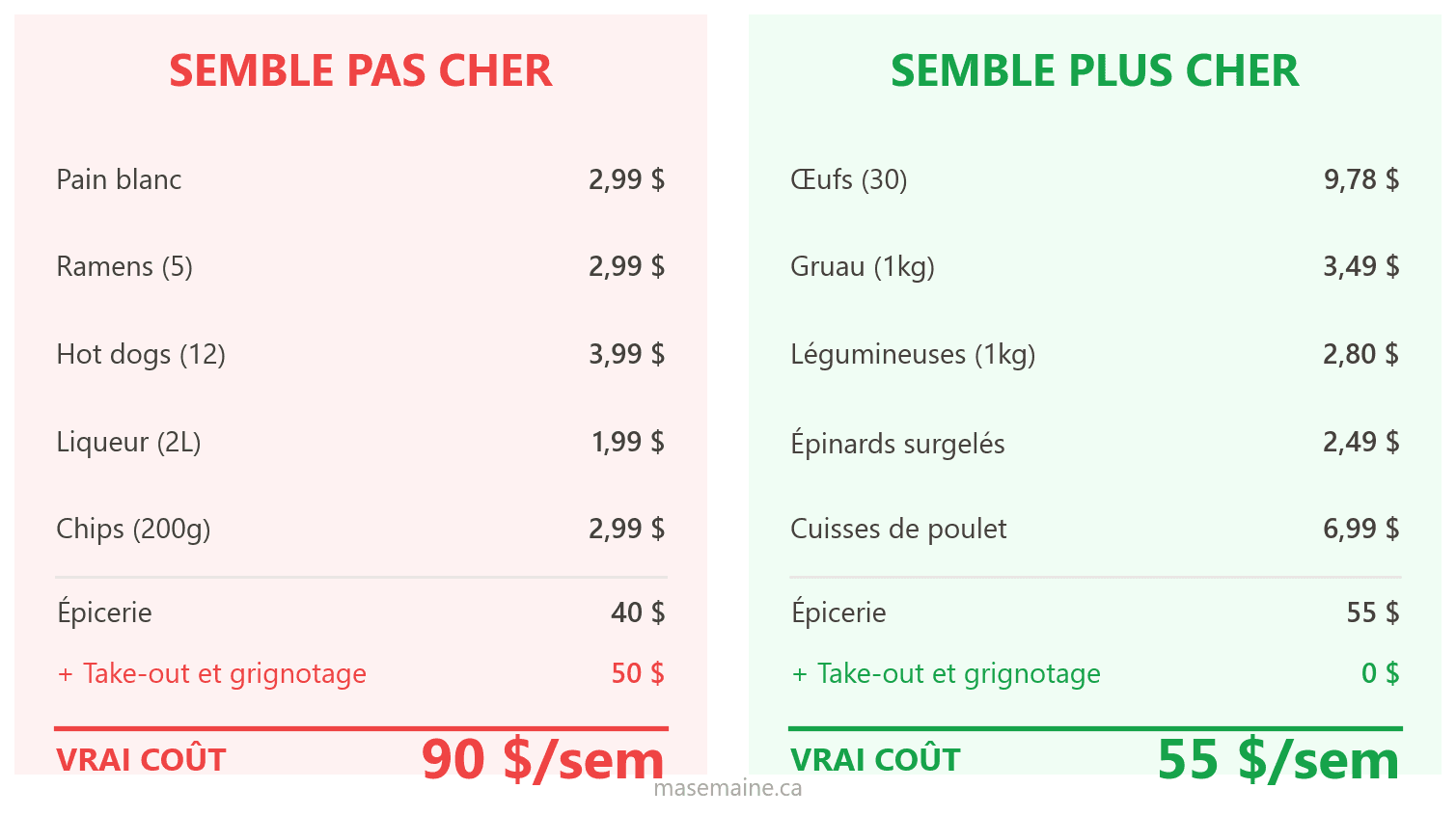
Vous avez économisé 30 $ cette semaine en achetant du pain blanc, des ramens et des hot dogs. Bonne affaire, non ? Puis jeudi soir, le frigo vous regarde dans le blanc des yeux et rien ne vous tente. Vous commandez 18 $ sur Uber Eats. Économies nettes : négatives.
C'est le piège de la nourriture cheap, et c'est ancré dans de la biologie, pas dans un manque de volonté. L'aliment le moins cher au kilo n'est pas le moins cher par unité de nutrition. Votre corps a des cibles nutritionnelles précises — quand elles ne sont pas atteintes, la faim persiste peu importe combien de calories vous avez ingurgitées.
Voici la science derrière ce phénomène, avec les vrais prix du Québec, pour que vous puissiez prendre des décisions d'épicerie basées sur des faits plutôt que sur le prix par 100 g.
Le vrai coût de la nourriture « pas chère »
Le cycle que vous connaissez probablement
La nourriture pauvre en nutriments crée une boucle coûteuse :
La nourriture dense en nutriments crée l'effet inverse :
Le problème, c'est qu'on compare les aliments en regardant le prix à la caisse — pas ce qu'ils font à votre corps les quatre heures suivantes. Un paquet de ramens à 0,60 $ semble imbattable. Sauf qu'il vous laisse affamé 90 minutes plus tard et vous coûte finalement 8 à 12 $ en grignotage et en commandes.
C'est quoi la densité nutritive (et comment la mesurer)
La densité nutritive, c'est la quantité de micronutriments utiles (vitamines, minéraux, fibres, protéines) par calorie ou par dollar dépensé. Il y a trois systèmes de mesure qui font consensus dans la littérature scientifique :
ANDI (Aggregate Nutrient Density Index), développé par le Dr Joel Fuhrman, mesure les nutriments par calorie sur une échelle de 1 à 1 000. Important : le système ANDI ne compte pas les protéines, les oméga-3 ni la vitamine B12, donc il favorise fortement les légumes-feuilles. À utiliser en complément, pas comme seule mesure.
NRF 9.3 (Nutrient-Rich Foods Index), de Fulgoni et al. (2009), note les aliments selon 9 nutriments à encourager et 3 à limiter (sodium, gras saturés, sucres ajoutés). Plus équilibré pour les aliments d'origine animale.
Densité nutritive par dollar (Drewnowski, 2010) — c'est celle qui compte le plus pour votre budget. Elle mesure combien de nutrition vous obtenez pour chaque dollar dépensé, et elle révèle des surprises.
13 aliments comparés par densité nutritive et prix au Québec
Les lentilles, les œufs, les épinards surgelés et les sardines offrent le meilleur rapport nutrition/dollar de loin. Le pain blanc, les ramens, les hot dogs et les chips sont riches en calories par dollar mais presque nuls en valeur nutritive réelle. Le boeuf haché se situe au milieu — vraiment dense en nutriments (surtout pour le fer, la B12 et le zinc), mais assez coûteux pour ne pas être votre principale source de protéines avec un budget serré. Achetez-le en solde et étirez-le dans le chili, la sauce à spaghetti et les sautés.
L'effet de levier des protéines — pourquoi le junk food vous fait manger plus
C'est la partie la plus importante à comprendre. En 2005, les biologistes Simpson et Raubenheimer ont publié ce qu'ils ont appelé l'hypothèse du levier protéique : les animaux, y compris les humains, mangent jusqu'à ce qu'ils atteignent leur cible de protéines — environ 15 % de l'apport énergétique. Si les repas sont dilués en protéines, on mange plus de calories totales pour atteindre cette cible.
Un essai contrôlé randomisé de Gosby et al. (2011) a mis ce mécanisme en évidence chez les humains :
- Le groupe qui mangeait une diète à 10 % de protéines a consommé 12 % plus de calories que le groupe contrôle (15 % de protéines)
- 70 % de ces calories excédentaires venaient du grignotage entre les repas, pas de portions plus grosses aux repas
- 57 % des collations étaient salées — chips, craquelins, biscuits salés
- Conclusion des auteurs : « Un changement dans l'environnement nutritionnel qui dilue les protéines alimentaires avec des glucides et des lipides favorise la surconsommation. »
Raubenheimer et Simpson (2019) ont par la suite montré qu'une baisse du contenu protéique moyen des aliments transformés — de 14 % à 12,5 % de l'apport énergétique — est corrélée avec la hausse de l'obésité dans les pays occidentaux.
En d'autres mots : les fabricants de produits transformés ont réduit les protéines (qui coûtent cher à produire) et ajouté des glucides et des lipides (moins chers). Résultat : vous mangez plus, et vous payez plus au total.
Le dîner à 2,45 $ qui coûte 11 $
La soupe aux lentilles n'est pas juste moins chère à l'achat. Elle est 8 à 10 fois moins chère dans la vraie vie, une fois que vous comptez ce qui se passe après.
C'est un exemple extrême — tout le monde qui mange des ramens ne commande pas un sous-marin deux heures plus tard. Mais le pattern est réel : même si vous cédez au take-out ou au grignotage seulement deux fois par semaine au lieu de chaque jour, ça représente quand même 15–25 $/semaine en dépenses non planifiées que des repas denses en nutriments auraient évitées.
L'indice de satiété — quels aliments cheap vous gardent vraiment plein
Holt et al. (1995) ont publié ce qu'on appelle l'indice de satiété : une mesure de combien différents aliments coupent la faim pendant deux heures après consommation. Le pain blanc = 100 comme référence.
Deux constats qui changent la façon d'épicérier :
- Les pommes de terre à 0,44–0,87 $/kg sont 3,2 fois plus rassasiantes que le pain blanc par dollar dépensé. Pas « meilleur pour la santé en général » — littéralement plus rassasiantes, mesurées en laboratoire.
- Le gruau à 0,12 $/portion est le déjeuner le plus rentable de n'importe quelle épicerie au Québec. Indice de satiété de 209, prix imbattable, facile à préparer.
La « boucle du frigo » — comment les repas pauvres en nutriments mènent au take-out
Monsivais et Drewnowski (2007) ont mesuré le coût de la nourriture saine versus le junk food par 1 000 kcal : 18,16 $ pour la nourriture nutritive versus 1,76 $ pour les aliments ultra-transformés. Ça semble confirmer que le junk, c'est moins cher. Mais le junk ne rassasie pas — alors les dépenses supplémentaires s'accumulent.
Darmon et Drewnowski (2015), dans une méta-analyse de 151 études, ont confirmé : la nourriture dense en énergie coûte moins par calorie, mais mène systématiquement à une alimentation de moindre qualité et à une surconsommation calorique. Le coût réel par unité de satiété est plus élevé, pas plus bas.
Voici ce que ça ressemble sur une vraie semaine :
La différence n'est pas dans la volonté. Elle est dans ce que le frigo contient le mercredi soir.
Le top 10 des aliments denses en nutriments et pas chers au Québec
Voici les aliments qui offrent le meilleur rapport densité nutritive / dollar dans les épiceries du Québec. Prix basés sur Maxi, Super C, Metro, IGA, Walmart, Provigo et Tigre Géant, jan–mars 2026.
Comment cuisiner chacun
1. Légumineuses sèches (lentilles, pois chiches, haricots) — La base absolue.
- Prix : ~2,60–3,20 $/kg selon le type (toutes les chaînes)
- Pourquoi c'est un champion : 20 à 25 g de protéines par 100 g sec, 120 % folate, 36 % fer. La meilleure catégorie d'aliments par dollar dans n'importe quelle épicerie. Lentilles, pois chiches, haricots noirs, haricots rouges, pois cassés — toutes sont championnes. Choisissez celles que vous aimez.
- Recette rapide : Soupe aux lentilles rouges (20 min), cari aux pois chiches (25 min), tacos aux haricots noirs (15 min).
- Conservation : Un an dans un contenant hermétique à l'abri de la lumière.
2. Œufs — Le meilleur rapport protéines/dollar en épicerie.
- Prix : 9,78 $/30 œufs chez Maxi ou Costco
- Pourquoi c'est un champion : Choline essentielle pour le cerveau, sélénium, B12. Protéines complètes à 0,33 $ l'unité.
- Recette rapide : Omelette aux épinards surgelés — 2 œufs + une poignée d'épinards, 5 minutes, ~0,90 $.
- Conservation : 3 à 5 semaines au réfrigérateur.
3. Épinards surgelés — Cueillis à maturité, congelés immédiatement.
- Prix : ~2,49 $/300 g chez la plupart des épiceries
- Pourquoi c'est un champion : Nutritionnellement identiques (et souvent supérieurs) aux épinards frais. Vitamine K à 309 % VQ par portion.
- Recette rapide : Ajoutez-les directement à n'importe quelle soupe, sauce ou smoothie sans presque changer le goût.
- Conservation : 12 mois au congélateur.
4. Sardines en conserve — La protéine la plus dense en nutriments et la moins chère au Québec, dollar pour dollar.
- Prix : ~2,49 $/boîte dans la plupart des épiceries
- Pourquoi c'est un champion : B12 à 373 % VQ, calcium, oméga-3 à 1,48 g par boîte. 9 g de protéines par dollar.
- Recette rapide : Mélangées avec de la moutarde et du citron sur du pain de grains entiers — lunch complet à ~2,80 $. Rillettes de sardines maison en 5 minutes.
- Conservation : 3 à 5 ans en conserve non ouverte.
5. Chou vert — Impressionnant à 1,08–1,74 $/kg.
- Prix : 1,08–1,74 $/kg chez Maxi, Super C, IGA
- Pourquoi c'est un champion : Vitamine C à 41 % VQ et K à 63 % VQ par portion. Fibres, folate, faible en calories.
- Recette rapide : Braisé avec de l'ail et de l'huile d'olive — de la nourriture sérieuse pour rien.
- Conservation : 2 à 3 semaines au frigo sans gaspillage.
6. Gruau — Quaker chez Metro, 3,49 $/kg.
- Prix : 3,49 $/kg en gros format
- Pourquoi c'est un champion : Manganèse à 158 % VQ, magnésium à 33 % VQ, fibres solubles pour la glycémie. Indice de satiété de 209.
- Recette rapide : Avec banane et beurre d'arachide, c'est 0,75 $/déjeuner. Cuisinez le soir pour du gruau du lendemain (overnight oats) — zéro effort le matin.
- Conservation : 1 à 2 ans dans un contenant hermétique.
7. Pommes de terre — Le légume le plus rassasiant au gramme, selon Holt et al. (1995).
- Prix : 0,44–0,87 $/kg chez Maxi, Walmart, Super C
- Pourquoi c'est un champion : Indice de satiété de 323 — le plus élevé de tous les aliments testés. Potassium, vitamine C, fibres avec la pelure.
- Recette rapide : Patate bouillie avec pelure — machine à satiété à 0,20 $/portion.
- Conservation : Plusieurs semaines dans un endroit sombre et frais.
8. Légumes surgelés mix — Pois, maïs, haricots, brocoli.
- Prix : 2,44–3,99 $ le sac de 750 g chez Maxi
- Pourquoi c'est un champion : Vitamines A et C, fibres, zéro gaspillage. Bouzari et al. (2015) ont confirmé que les légumes surgelés retiennent autant de vitamines que les légumes frais, sinon plus.
- Recette rapide : 3 minutes au micro-ondes — ajoutez à n'importe quel repas instantanément.
- Conservation : 12 mois au congélateur.
9. Tomates en conserve — La base de 80 % des sauces et des soupes pour rien.
- Prix : 1,67–1,99 $ pour 796 ml chez Provigo (sans nom)
- Pourquoi c'est un champion : Le lycopène (antioxydant) est plus biodisponible dans les tomates cuites que dans les tomates fraîches. Fer, vitamine C, faible en sodium.
- Recette rapide : Base de soupe, sauce tomate maison, shakshuka — toujours dans l'armoire, toujours utile.
- Conservation : 2 à 5 ans en conserve non ouverte.
10. Cuisses de poulet (os) — Attendez les soldes.
- Prix : 4,30–8,97 $/kg chez Maxi ou Super C
- Pourquoi c'est un champion : Protéine animale la plus abordable et la plus savoureuse. B6, niacine, zinc, sélénium. L'os donne du bouillon gratuit.
- Recette rapide : Cuisez en gros lot au four avec des patates et des légumes surgelés — 5 minutes de prep, 35 minutes pendant que vous faites autre chose.
- Conservation : 9 mois au congélateur (portions individuelles).
Mention spéciale :
- Yogourt grec (~7,50 $/750 g) — 10 g de protéines par 100 g, calcium, probiotiques. Le meilleur rapport protéines/dollar en produits laitiers.
- Lait (4,49–4,75 $/2L chez IGA) — calcium, vitamine D, B12. Le prix est réglementé au Québec (peu de rabais en circulaire), mais la nutrition par dollar reste solide.
- Fromage en bloc (4,88–5,48 $/400 g chez Maxi/Super C) — 25 g de protéines par 100 g, calcium 72 % VQ. Meilleur rapport en solde.
- Thon en conserve (0,99–1,67 $/boîte)
- Beurre d'arachide (4,97–6,00 $)
- Pâtes (1,25–1,67 $)
- Brocoli (1,48–1,77 $)
Pour une liste d'épicerie complète par allée, consultez notre modèle gratuit.
La question de la viande — quelles coupes offrent le meilleur rapport?
La viande occupe une place importante dans le panier d'épicerie des familles québécoises. Les écarts de protéines par dollar entre les coupes sont dramatiques — l'épaule de porc livre presque 4x plus de protéines par dollar que le bœuf haché extra-maigre. Le bœuf excelle en fer, B12 et zinc d'une manière que le poulet et le porc ne peuvent pas égaler, mais il coûte nettement plus cher par gramme de protéines au prix régulier. Le bon réflexe : acheter le bœuf en solde, et compter sur l'épaule de porc et les cuisses de poulet pour les repas de semaine.
En pratique — une semaine, deux approches
Concrètement, qu'est-ce que ça change sur la facture totale ?
Approche A — « Acheter cheap » Pain blanc, ramens, hot dogs, céréales sucrées, chips, biscuits. Budget épicerie : ~40 $. Mais la faim revient vite. Mercredi, une pizza (25 $). Vendredi, un drive-through (15 $). Fin de semaine, la moitié de l'épicerie traîne encore dans les armoires.
Approche B — « Acheter intelligent » Lentilles, œufs, légumes surgelés, gruau, cuisses de poulet en solde, chou, patates. Budget épicerie : ~55 $. Les repas tiennent. Aucun take-out de la semaine. Zéro gaspillage. Pour des idées concrètes sur comment bien manger pour 75 $/semaine au Québec, consultez notre guide complet.
L'approche A coûte ~90 $ par semaine (40 $ épicerie + 50 $ take-out/grignotage). L'approche B coûte ~55 $. Pour mettre ça en contexte, le Rapport sur les prix alimentaires au Canada 2026 (Université Dalhousie) prévoit une moyenne de 78 $ par semaine par personne pour l'épicerie. L'approche dense en nutriments de cet article revient à 30 % sous la moyenne nationale — sans sacrifier la qualité nutritive. Sur un mois, la différence entre les deux approches est de 140 $. Sur un an : 1 680 $ restés dans votre compte de banque, sans sacrifier la qualité nutritive — en l'améliorant.
Pour maximiser vos économies, suivez les meilleurs rabais d'épicerie au Québec chaque semaine — les prix des cuisses de poulet et des légumes surgelés varient de 30 à 50 % selon les circulaires.
Comment appliquer tout ça chaque semaine (sans volonté)
Tout ce qui est dans cet article fonctionne — mais seulement si vous planifiez vos repas et magasinez en conséquence. C'est la partie difficile. MaSemaine automatise les trois étapes qui font que manger dense en nutriments tient dans le temps :
Étape 1 : Dites à l'app ce que vous aimez — pas ce que vous « devriez » manger
Personne ne vous force à manger des lentilles. Vous choisissez le nombre de personnes, le nombre de repas et vos préférences. L'IA génère des recettes basées sur des aliments denses en nutriments — mais des recettes que votre famille va vraiment manger.
Étape 2 : Les rabais de la semaine sont intégrés automatiquement
L'app lit les circulaires de Maxi, Super C, Metro, IGA, Provigo, Walmart et Tigre Géant chaque jeudi. Quand les cuisses de poulet sont à 4,30 $/kg chez Maxi au lieu de 8,97 $ chez Metro, vos recettes s'ajustent. L'approche dense en nutriments devient aussi l'approche chasseur de rabais.
Étape 3 : Votre liste d'épicerie montre le meilleur prix par magasin
Pas de devinette. Chaque article montre le prix actuel dans chaque magasin qui l'a en inventaire. La liste est organisée par allée pour que vous ne vous promeniez pas et n'achetiez pas de chips par impulsion.
Bonus : Vérifiez l'équilibre nutritionnel de votre semaine en un clic
Après la planification, le résumé nutritionnel montre vos protéines, fibres, légumes et micronutriments pour toute la semaine. Si mercredi est faible en protéines, vous le saurez avant d'aller épicérier — pas après être planté devant le frigo à 20 h.
Foire aux questions
La nourriture santé est-elle vraiment moins chère que la nourriture cheap ? Par kilo ou par calorie, non. Mais quand vous comptez ce que vous dépensez en grignotage et en take-out parce que la nourriture cheap ne vous rassasie pas, la réponse devient oui. Monsivais et Drewnowski (2007) ont mesuré 18,16 $/1 000 kcal pour les aliments nutritifs versus 1,76 $ pour le junk. Mais le junk provoque de la surconsommation — vous finissez par manger (et acheter) plus.
J'aime pas les lentilles. Quelles sont les alternatives ? Les lentilles ne sont qu'une option dans la famille des légumineuses — et elles sont toutes des championnes nutritionnelles. Les pois chiches fonctionnent dans les caris, le hummus et les salades. Les haricots noirs font des tacos et du chili. Les pois cassés font des soupes consistantes. Les haricots rouges vont dans les ragoûts. Toutes livrent 20 à 25 g de protéines par 100 g sec à des prix comparables. Au-delà des légumineuses : les œufs (9,78 $/30, ~0,33 $ l'unité), les cuisses de poulet en solde (4,30–4,99 $/kg) et le thon en conserve (0,99–1,67 $/boîte) donnent des résultats similaires. L'objectif est 20 à 30 g de protéines par repas — pas un aliment en particulier.
Combien de protéines vise-t-on par repas pour la satiété ? Les études sur l'hypothèse du levier protéique suggèrent que 20 à 30 g de protéines par repas est suffisant pour activer les signaux de satiété efficacement. Deux œufs = 12 g. Une cuisse de poulet = 25 à 30 g. Une portion de soupe aux lentilles = 18 à 22 g. Viser 20 g par repas est un objectif pratique et atteignable sans suppléments.
Les légumes surgelés sont-ils aussi nutritifs que les légumes frais ? Oui — et souvent plus. Les légumes destinés à la congélation sont cueillis à maturité optimale et congelés dans les heures qui suivent. Les légumes « frais » qui ont voyagé 3 000 km dans un camion réfrigéré pendant cinq jours ont perdu une partie significative de leurs vitamines C et B. Pour le brocoli, les épinards et les haricots, le surgelé est souvent la meilleure option nutritive et économique au Québec en hiver.
« Les lentilles et les soupes, ça prend pas une éternité à cuisiner ? » Les lentilles rouges cuisent en 15 minutes — pas besoin de trempage. Une soupe aux lentilles du début à la fin, c'est 20–25 minutes, moins long qu'attendre une livraison Uber Eats. Du riz frit aux œufs avec des légumes surgelés, c'est 10 minutes. Des cuisses de poulet en plaque avec des patates, c'est 5 minutes de prep et 35 minutes au four pendant que vous faites autre chose. Le truc : cuisiner en lot. Faites une double batch de soupe dimanche, portionnez, et vous avez 4–5 dîners prêts à réchauffer en 3 minutes. La fonction meal prep de MaSemaine est faite exactement pour ça — elle vous dit quoi cuisiner d'avance et dans quel ordre.
« Est-ce que ça s'applique aussi aux familles ? » L'économie se multiplie — et s'améliore même pour les familles, parce que les formats économiques (sac de 10 lb de patates, gruau en gros format, 30 œufs) deviennent plus pratiques. Une famille de 4 qui achète les aliments denses en nutriments de cet article dépense environ 50–60 $/semaine en épicerie là où une personne seule dépense 40–50 $, parce que le coût par unité baisse avec les gros formats. Les économies sur le take-out évité sont aussi proportionnellement plus grandes : une soirée pizza évitée sauve 35–50 $ pour une famille au lieu de 25 $ pour une personne seule.
D'où viennent les prix dans cet article ? Les prix proviennent des circulaires publiées au Québec de janvier à mars 2026 (Maxi, Super C, Metro, IGA, Provigo, Walmart, Tigre Géant) et des données du USDA FoodData Central pour les valeurs nutritives. Les prix tablette sont des estimations basées sur des relevés en magasin sur la même période.
Références
- Simpson, S.J. & Raubenheimer, D. (2005). Obesity: the protein leverage hypothesis. Obesity Reviews, 6(2), 133–142. https://doi.org/10.1111/j.1467-789X.2005.00178.x
- Gosby, A.K., et al. (2011). Testing protein leverage in lean humans: a randomised controlled experimental study. PLOS ONE, 6(10), e25929. https://doi.org/10.1371/journal.pone.0025929
- Raubenheimer, D. & Simpson, S.J. (2019). Protein Leverage: Theoretical Foundations and Ten Points of Clarification. Obesity, 27(8), 1225–1238. https://doi.org/10.1002/oby.22531
- Holt, S.H., et al. (1995). A satiety index of common foods. European Journal of Clinical Nutrition, 49(9), 675–690.
- Drewnowski, A. (2010). The Nutrient Rich Foods Index helps to identify healthy, affordable foods. American Journal of Clinical Nutrition, 91(4), 1095S–1101S. https://doi.org/10.3945/ajcn.2010.28450D
- Fulgoni, V.L., et al. (2009). Development and validation of the nutrient-rich foods index: A tool to measure nutritional quality of foods. Journal of Nutrition, 139(8), 1549–1554. https://doi.org/10.3945/jn.108.101360
- Fuhrman, J. (2012). Eat to Live. Little, Brown and Company. Scores ANDI publiés sur DrFuhrman.com.
- Monsivais, P. & Drewnowski, A. (2007). The rising cost of low-energy-density foods. Journal of the American Dietetic Association, 107(12), 2071–2076. https://doi.org/10.1016/j.jada.2007.09.009
- Darmon, N. & Drewnowski, A. (2015). Contribution of food prices and diet cost to socioeconomic disparities in diet quality and health. Nutrition Reviews, 73(10), 643–660. https://doi.org/10.1093/nutrit/nuv027
- USDA FoodData Central. (2024). FoodData Central Search Results. U.S. Department of Agriculture. https://fdc.nal.usda.gov/
- Drewnowski, A. & Specter, S.E. (2004). Poverty and obesity: the role of energy density and energy costs. American Journal of Clinical Nutrition, 79(1), 6–16. https://doi.org/10.1093/ajcn/79.1.6
- Statistique Canada. (2023). Enquête sur les dépenses des ménages, tableau 11-10-0222-01. https://www150.statcan.gc.ca/
- Bouzari, A., Holstege, D. & Barrett, D.M. (2015). Vitamin retention in eight fruits and vegetables: a comparison of refrigerated and frozen storage. Journal of Agricultural and Food Chemistry, 63(3), 957–962. https://doi.org/10.1021/jf5058793
- Health Canada. Canadian Nutrient File (2015 edition). https://food-nutrition.canada.ca/cnf-fce/index-eng.jsp
- Canada's Food Price Report 2026. Dalhousie University et al. https://www.dal.ca/sites/agri-food/research/canada-s-food-price-report-2026.html
Lire aussi :
- Bien manger pour 75 $/semaine au Québec
- Les aliments les moins chers au Québec font aussi perdre du poids
- Les meilleurs rabais d'épicerie au Québec chaque semaine
- Comment planifier ses repas pour économiser — Guide étape par étape
- Quand manger ses glucides : un ultra-traileur contre un homme de 250 lb en perte de poids