Bien manger pour 75 $/semaine par personne au Québec (avec les vrais prix)
Il y a un chiffre qui revient constamment dans les forums, les groupes Facebook et les fils Reddit au Québec : 75 $ par semaine par personne pour l'épicerie. Ça semble serré. Ça l'est. La moyenne québécoise tourne plutôt autour de 90 $ par semaine par personne — environ 360 $/mois — selon les dernières données de Statistique Canada.
Donc 75 $/semaine, ça veut dire dépenser environ 17 % de moins que le Québecois moyen. Pas impossible, mais ça n'arrive pas tout seul. Ça demande un plan, la volonté de cuisiner maison la plupart des jours, et une compréhension réaliste de où passe chaque dollar.
Voici comment les chiffres fonctionnent, a quoi ça ressemble concretement, et si l'effort en vaut la peine.
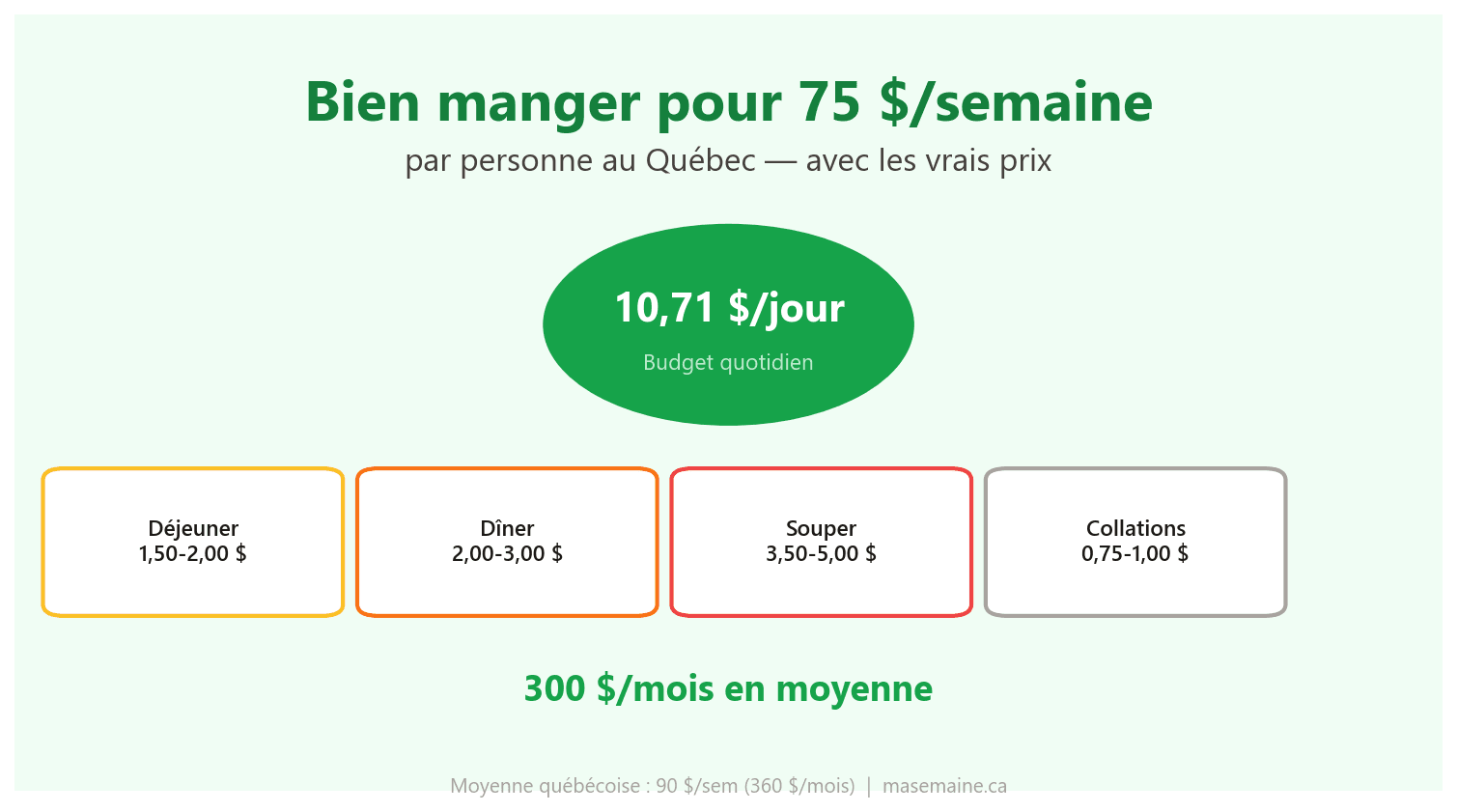
Les maths : 10,71 $ par jour
A 75 $/semaine, vous avez 10,71 $ par jour pour couvrir le déjeuner, le diner, le souper et les collations. Ça se repartit a peu près comme ceci :
L'idee cle : certaines journees vont couter 8 $, d'autres 13 $. Le budget fonctionne sur une moyenne hebdomadaire, pas un plafond quotidien. Un souper de poulet roti le mercredi a 6 $ est compensé par une soupe aux lentilles le jeudi a 2,50 $.
Répartition du budget par categorie
Avant de pouvoir atteindre 75 $/semaine, il faut savoir où va l'argent. Voici une ventilation réaliste pour une personne au Québec :
Les protéines prennent la plus grosse part. C'est la où les rabais de circulaires font la plus grande différence. Acheter des hauts de cuisse de poulet a 3,99 $/kg en solde au lieu de 7,99 $/kg a prix régulier coupe votre budget protéines presque de moitie pour ce repas.
10 repas économiques a moins de 5 $ par personne
Ce sont les piliers d'un budget de 75 $/semaine au Québec. Chaque prix ci-dessous est basé sur les prix actuels des épiceries québécoises, en supposant qu'on achète les produits de basé en solde quand c'est possible.
1. Gruau avec banane et beurre d'arachide — ~0,75 $/portion Le gruau en gros format (Sans nom chez Maxi, 4,49 $/kg) dure des semaines. Une banane (0,20 $) et une cuillère de beurre d'arachide (0,15 $). Le déjeuner nutritif le moins cher de n'importe quelle épicerie.
2. Riz frit aux oeufs — ~2,00 $/portion Deux oeufs (0,50 $), une tasse de riz restant (0,30 $), des légumes surgeles (0,50 $), sauce soya et huile de sesame (0,20 $). Nourrissant, rapide, et ça utilise ce qu'on a déjà.
3. Cuisse de poulet avec riz et carottes roties — ~3,50 $/portion Deux hauts de cuisse avec os a 4,49 $/kg en solde (1,80 $), une tasse de riz (0,30 $), trois grosses carottes (0,60 $), huile et assaisonnement (0,30 $). C'est le repas de basé de toute cuisine a petit budget au Québec.
4. Pates bolognaise — ~3,25 $/portion Boeuf haché ou porc haché a 10,76 $/kg (2,15 $ pour 200 g), pates (0,35 $ pour 100 g), tomates en conserve (0,50 $), oignon et ail (0,25 $). Faites un gros chaudron et ça couvre deux soupers et un diner.
5. Chili aux haricots et légumes — ~1,75 $/portion Haricots rouges en conserve (1,29 $), tomates en conserve (0,99 $), oignon, poivrons et épices. Servez sur du riz. Un des repas complets les moins chers qu'on peut faire, et ça se congelé parfaitement.
6. Soupe aux lentilles — ~1,50 $/portion Lentilles rouges (2,49 $/sac, pour 4-5 portions), carottes, céleri, oignon, tomates en conserve, cumin. Un plein chaudron coute moins de 6 $ et nourrit une personne pour trois repas.
7. Grilled cheese et soupe aux tomates — ~2,25 $/portion Deux tranches de pain (0,30 $), fromage (0,70 $), beurre (0,10 $), et un bol de soupe aux tomates maison a partir de conserves (1,15 $). De la nourriture reconfortante qui coute presque rien.
8. Porc effiloché sur un pain — ~3,00 $/portion Épaule de porc en solde a 5,49 $/kg (régulier 8,99 $/kg). Faites mijoter un morceau d'1 kg et vous obtenez 4-5 portions de porc effiloché. Ajoutez un pain, une salade de chou a partir d'un sac de chou a 2,50 $, et vous avez un repas qui a l'air d'un plat de resto.
9. Salade de pates au thon — ~2,00 $/portion Une conserve de thon (1,49 $ chez Maxi), des pates cuites (0,35 $), mayonnaise et moutarde (0,20 $), céleri et oignon en des (0,20 $). En lunch ou en souper rapide. Se conserve bien au frigo pour deux jours.
10. Soupe aux pois — ~1,25 $/portion Pois jaunes cassés (2,29 $/sac), un os de jambon ou un jarrêt de porc fumé (2-3 $), carottes, céleri, oignon. Ce classique québécois produit un chaudron immense pour moins de 7 $. Ça se congelé bien et c'est encore meilleur le lendemain.
Une semaine type : vrais repas, vrais prix
Voici a quoi ressemble une vraie semaine pour une personne a 75 $. Ce n'est pas un idéal — c'est bâti a partir des prix actuels des épiceries québécoises.
Déjeuners
Diners
Soupers
Collations et extras
Total hebdomadaire
Un instant — 46,70 $? C'est bien en dessous de 75 $. Et c'est exactement le point. La semaine ci-dessus est une semaine légère. En realité, vous aurez des semaines ou vous achetez un plus gros morceau de viande (12-15 $), ou vous réapprovisionnez le garde-manger (8-10 $), ou vous achetez plus de fruits et légumes (20 $+). La cible de 75 $ vous donne de la marge pour ces semaines plus coûteuses tout en maintenant la moyenne sur le mois.
Un patron mensuel réaliste ressemble a ceci :
- Semaine 1 : 55 $ (semaine légère, garde-manger déjà garni)
- Semaine 2 : 85 $ (réapprovisionnement protéines, achat d'huile et d'épices)
- Semaine 3 : 65 $ (retour au léger, pas de gros achats)
- Semaine 4 : 95 $ (gros achat de protéines, on profite des soldes)
- Moyenne mensuelle : 75 $/semaine (300 $ au total)
Stratégies d'achat qui font vraiment la différence
Toutes les stratégies d'économie ne se valent pas. Voici celles qui comptent le plus au niveau de 75 $/semaine, classées par impact.
1. Achetez les protéines en solde — toujours
C'est la seule habitude qui a le plus d'impact. Les protéines sont votre plus grosse depense, et l'écart de prix entre le régulier et le solde est énorme au Québec :
Quand les cuisses de poulet sont a 3,99 $/kg chez Maxi, achetez-en assez pour la semaine. Quand l'épaule de porc est a 5,49 $/kg chez Super C, achetez-en deux et congelez-en un. Laissez les circulaires guider vos protéines — planifiez vos repas après avoir vu ce qui est en solde, pas avant.
2. Les marques maison pour les produits de base
La différence de qualité entre Sans nom (Maxi/Provigo), Compliments (IGA/Sobeys) et Selection (Metro) versus les marques nationales est négligeable pour les produits de base. La différence de prix, elle, ne l'est pas :
- Tomates en conserve : Sans nom 0,99 $ vs. marque nationale 2,49 $
- Pates (900 g) : Selection 1,49 $ vs. Barilla 3,29 $
- Legumes surgeles : Compliments 2,49 $ vs. Green Giant 4,49 $
Sur un mois, les marques maison pour les produits de basé seulement font économiser 15 $ a 25 $ par personne.
3. Cuisinez en lot et utilisez les restes strategiquement
Chaque repas de gros chaudron dans le plan ci-dessus (soupe aux lentilles, bolognaise, chili, soupe aux pois) produit 3-4 portions a partir d'une seule session de cuisine. Les deuxième et troisième portions ne coûtent presque rien — les ingredients coûteux (proteine, conserves) sont déjà payés. Les restes pour le lunch sont la raison principale pour laquelle la colonne diners reste sous 2 $/jour.
4. Achetez les fruits et légumes de saison
Le Québec a une saison de culture courte mais intense. De juin a octobre, les produits locaux dans les marchés fermiers et même les épiceries régulieres baissent significativement en prix :
- Tomates d'ete : 2,99 $/lb local vs. 4,99 $/lb importé en hiver
- Courgettes : 0,99 $/lb en aout vs. 2,49 $/lb en février
- Ble d'Inde : 6 pour 3,00 $ en saison vs. 1,50 $ chacun surgele
En hiver, passez aux légumes-racines (carottes, patates, navets, oignons), aux légumes surgeles et aux tomates en conserve. C'est pas cher a l'année et ça garde bien ses nutriments.
5. Magasinez dans les chaines a rabais
Au Québec, l'écart de prix entre les magasins est reel. Pour le même panier de produits de basé :
- Maxi et Super C sont systématiquement les moins chers pour les articles courants
- Walmart égale souvent ou bat leurs prix sur les produits emballés
- Metro et IGA tendent a être 10-15 % plus chers en moyenne, mais leurs soldes peuvent être excellents
- Tigre Géant vaut la peine d'être verifie pour des aubaines spécifiques sur les produits du garde-manger
Pas besoin de visiter quatre magasins. Choisissez une chaine a rabais comme magasin principal et complétez avec les rabais des circulaires quand les économies justifient le deplacement.
Les pièges courants
Savoir quoi éviter est aussi important que savoir quoi acheter.
Acheter des aliments "santé" transformes. Les kits de salade prélavés (4,99 $), les pots de yogourt individuels (6,99 $/paquet de 6) et les légumes précoupé (5,99 $/barquette) coûtent une prime énorme pour la commodite. Une laitue (1,99 $), un pot de yogourt de 650 g (3,49 $) et des carottes entieres (2,49 $/2 lb) offrent la même nutrition a moitié prix.
Acheter trop de produits frais. Le ménage canadien moyen jette 1 100 $/an de nourriture — et les fruits et légumes sont le coupable numéro un. Achetez seulement ce que vous allez manger cette semaine. Un sac d'epinards a 3,99 $ dont vous utilisez la moitié et jetez le reste vous a couté 2 $ la portion, pas 1 $.
Ignorer le congélateur. Les légumes surgeles sont cueillis et congelés a maturite. Ils sont nutritionnellement equivalents (et souvent meilleurs) aux légumes "frais" qui ont voyage 3 000 km jusqu'a votre épicerie. A 2,49 $/sac, les pois, le mais et les haricots verts surgeles sont des incontournables du budget.
Faire l'épicerie le ventre vide. Ça semble cliché parce que c'est vrai. Les etudes montrent que les acheteurs affames dépensent 20-30 % de plus en moyenne. Mangez avant de partir.
Acheter les protéines a plein prix parce que "c'est ça que j'ai le gout de cuisiner". C'est l'habitude la plus coûteuse dans n'importe quelle cuisine. A 75 $/semaine, on ne peut pas se permettre du boeuf haché a 19,82 $/kg quand il est a 10,76 $/kg a l'épicerie d'en face. Laissez les rabais guider le menu.
Soyons honnêtes : quand ça ne fonctionne pas
Un budget de 75 $/semaine ne marchera pas toutes les semaines, et prétendre le contraire serait malhonnête. Voici quand ça déraille :
- Les fetes et les rassemblements. L'Action de grace, Noel et Paques font exploser n'importe quel budget hebdomadaire. Planifiez-les séparément.
- Les semaines où rien d'intéressant n'est en solde. Certaines semaines, les circulaires sont plates. Vos coûts de protéines seront plus élevés, et votre total hebdomadaire pourrait atteindre 90-95 $.
- Les restrictions alimentaires. Les régimes sans gluten, sans lactose ou spécialisés coûtent plus cher. Les produits de basé qui rendent 75 $/semaine possible (pates, pain, riz, oeufs, produits laitiers) ne sont pas tous disponibles pour tout le monde.
- Les déserts alimentaires. Tout le monde n'a pas un Maxi ou un Super C a proximite. Si votre seule option est un dépanneur ou une épicerie a prix plus eleve, 75 $/semaine n'est peut-être pas réaliste.
L'objectif n'est pas la perfection. C'est une moyenne de 75 $/semaine sur le mois — environ 300 $/mois. Certaines semaines vous serez a 60 $. D'autres a 90 $. C'est normal et attendu.
Comment appliquer tout ça chaque semaine (sans volonté)
Tout ce qui est dans cet article fonctionne — mais seulement si vous planifiez vos repas et magasinez en conséquence. C'est la partie difficile. MaSemaine automatise les trois étapes qui font que manger bien a 75 $/semaine tient dans le temps :
Étape 1 : Dites a l'app ce que vous aimez — pas ce que vous « devriez » manger
Personne ne vous force a manger des lentilles sept jours sur sept. Vous choisissez le nombre de personnes, le nombre de repas et vos préférences. L'IA génère des recettes économiques basées sur des aliments que votre famille va vraiment manger — pas un menu de privation.
Étape 2 : Les rabais de la semaine sont intégrés automatiquement
L'app lit les circulaires de Maxi, Super C, Metro, IGA, Provigo, Walmart et Tigre Géant chaque jeudi. Quand les cuisses de poulet sont a 3,99 $/kg chez Maxi au lieu de 7,99 $ chez Metro, vos recettes s'ajustent. Plus besoin de scruter les circulaires vous-même.
Étape 3 : Votre liste d'épicerie montre le meilleur prix par magasin
Pas de devinette. Chaque article montre le prix actuel dans chaque magasin qui l'a en inventaire. La liste est organisée par allée pour que vous ne vous promeniez pas et n'achetiez pas des chips par impulsion.
Foire aux questions
Est-ce que 75 $/semaine par personne, c'est réaliste au Québec en 2026? Oui, mais ça demande un effort constant. La moyenne québécoise est plus près de 90 $/semaine par personne (360 $/mois) selon Statistique Canada [1]. Atteindre 75 $ signifie dépenser environ 17 % de moins que la moyenne, ce qui est faisable grâce à la planification de repas, la cuisine maison, l'achat de protéines en solde et l'utilisation des marques maison. C'est pas sans effort, mais c'est pas extrême non plus.
C'est quoi la protéine la moins chere au Québec? Les oeufs sont presque toujours la protéine animale la moins chere au gramme — environ 4-5 $ la douzaine, avec chaque oeuf fournissant 6 g de proteine. Ensuite : les cuisses de poulet en solde (3,99 $/kg), le thon en conserve (1,49 $/boite), les lentilles seches (2,49 $/sac pour 8+ portions) et les haricots en conserve (1,29 $/boite). Le porc haché est souvent moins cher que le boeuf haché et fonctionne dans la plupart des mêmes recettes.
Est-ce qu'une famille de 4 peut manger pour 300 $/semaine (75 $/personne) au Québec? C'est plus serré pour les familles parce que les enfants mangent moins mais on ne peut pas toujours acheter en plus petites quantites. Une cible plus réaliste pour une famille de 4 est 250-280 $/semaine (62-70 $/personne), parce que les achats en gros offrent des économies supplémentaires qui ne sont pas disponibles pour une seule personne. Consultez notre plan de repas complet pour une famille de 4 a 150 $/semaine pour un detail complet.
Est-ce qu'il faut magasiner dans plusieurs épiceries pour atteindre 75 $/semaine? Non. Choisissez une chaine a rabais (Maxi ou Super C) comme magasin principal. Ça seul vous donne 80 % des économies. Vérifier les circulaires d'autres magasins et faire un deuxième arrêt vaut la peine seulement pour les gros rabais — comme des cuisses de poulet a 3,99 $/kg quand votre magasin les a a 7,99 $/kg. Ne traversez pas la ville pour économiser 0,50 $ sur des tomates en conserve.
Combien de temps ça prend par semaine? Comptez environ 2 a 3 heures de cuisine par semaine si vous faites de la cuisine en lot. Un gros chaudron de soupe ou de bolognaise le dimanche (45 minutes) couvre 3 a 4 repas. Les soirs de semaine, la plupart des recettes ci-dessus prennent 20 a 30 minutes. Le truc, c'est que la cuisine en lot réduit votre temps total comparé a cuisiner chaque repas individuellement — et élimine les soirs de « trop fatigué, on commande ».
D'où viennent les prix dans cet article? Les prix proviennent des circulaires publiées au Québec de janvier a mars 2026 (Maxi, Super C, Metro, IGA, Provigo, Walmart, Tigre Géant) et de relevés en magasin sur la même période. Les prix « réguliers » sont les prix tablette hors solde. Les prix « en solde » sont les prix circulaire confirmés. Les données nutritionnelles proviennent du USDA FoodData Central [2].
Est-ce que c'est bon pour la santé de manger a 75 $/semaine? Oui — si vous suivez le genre de plan présenté ici. Un budget serré force souvent de meilleurs choix : plus de cuisine maison, moins de produits ultra-transformés, plus de legumineuses et de légumes. Le risque apparaît quand un budget serré mène a du « cheap » au lieu de « pas cher mais nutritif ». La différence est expliquée en detail dans notre guide sur la densité nutritive.
Références
- Statistique Canada. (2023). Enquête sur les dépenses des ménages, tableau 11-10-0222-01. https://www150.statcan.gc.ca/
- USDA FoodData Central. (2024). FoodData Central Search Results. U.S. Department of Agriculture. https://fdc.nal.usda.gov/
- Canada's Food Price Report 2026. Dalhousie University et al. https://www.dal.ca/sites/agri-food/research/canada-s-food-price-report-2026.html
- Chandon, P. & Wansink, B. (2012). Does food marketing need to make us fat? A review and solutions. Nutrition Reviews, 70(10), 571–593. https://doi.org/10.1111/j.1753-4887.2012.00518.x
- Godfray, H.C.J., et al. (2010). Food security: the challenge of feeding 9 billion people. Science, 327(5967), 812–818. https://doi.org/10.1126/science.1185383
Pour aller plus loin :
- Combien les Canadiens dépensent vraiment a l'épicerie — et comment dépenser moins
- Comment planifier ses repas pour économiser : étape par étape
- 5 astuces pour reduire le gaspillage alimentaire au Québec
- Pourquoi la nourriture cheap vous coûte plus cher : le guide de la densité nutritive
- Quand manger ses glucides : un ultra-traileur contre un homme de 250 lb en perte de poids