10 Foods That Got Most Expensive in Canada in 2026 (and What to Buy Instead)
You pack the same cart you packed a year ago. Same chicken, same coffee, same lettuce. You get to the checkout and the total is $20 higher — for nothing extra. You are not imagining it.
According to the Canada Food Price Report 2026, a family of four will spend $17,571.79 on food this year — an increase of $994.63 over 2025. That is the price of a weekend away, or a month of daycare, gone to the same groceries.
But the pain is not spread evenly. A few categories did almost all of the damage. Once you know which items jumped the most, you can swap them out without changing how your family actually eats.
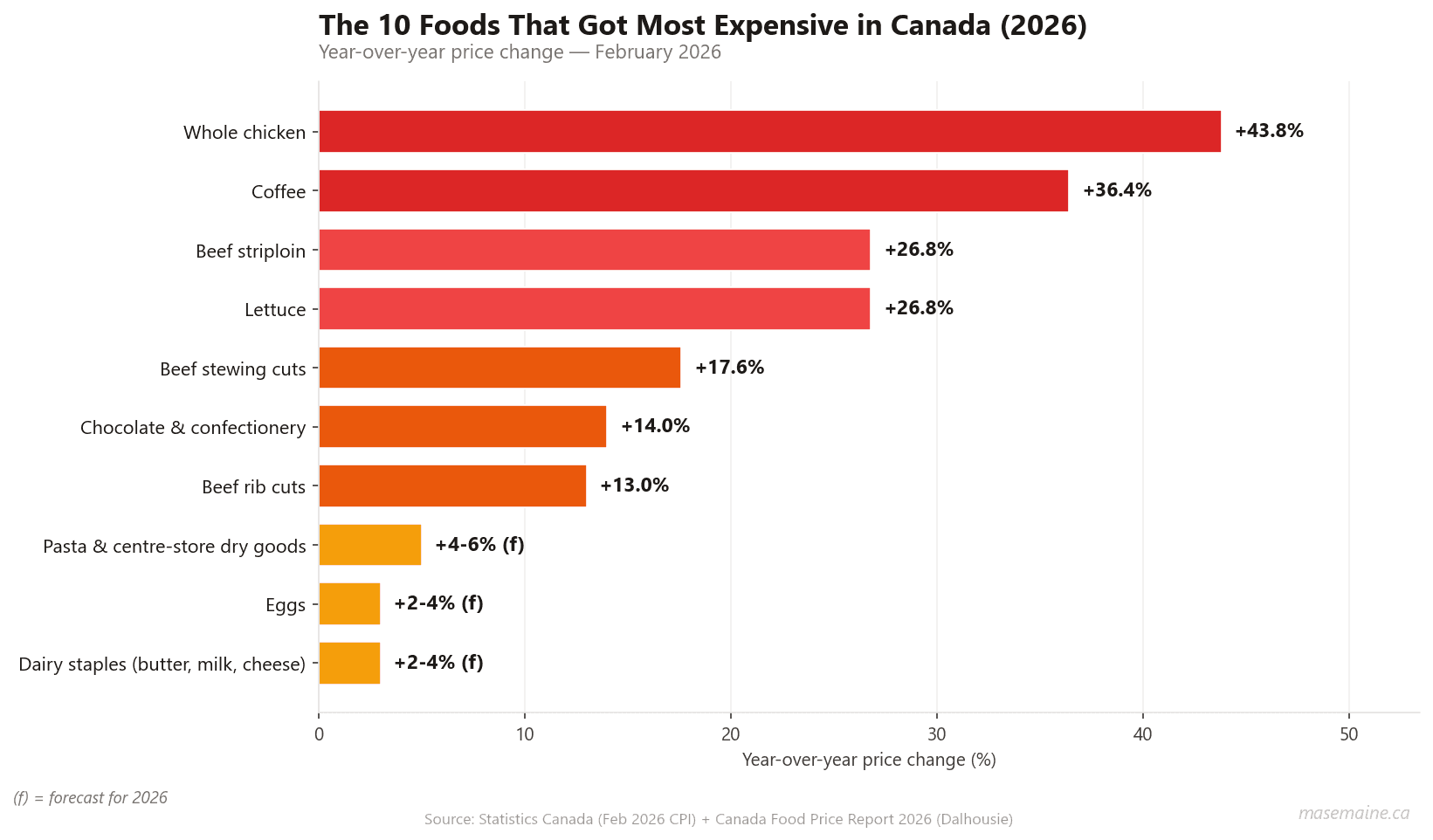
The 10 foods that got most expensive
Source: Statistics Canada (February 2026 CPI data via BNN Bloomberg) and the Canada Food Price Report 2026 from Dalhousie University. Items marked "(f)" are category forecasts for 2026, not measured year-over-year changes.
The big picture: grocery inflation is still running hot
Overall inflation in Canada cooled to 1.8% in February 2026. Grocery prices did not get the memo — they rose 5.7% year-over-year, more than three times the headline rate. Food purchased from stores was up 4.1% on its own, and meat and specific produce items drove the difference.
A few numbers that put this in context:
- Grocery prices are now 27% higher than five years ago
- 34% of Canadian households drew from savings or took on debt last year specifically to buy food
- Quebec and Ontario are projected to sit above the national average at 6%+ food inflation in 2026
- Nova Scotia is the hardest-hit province at 8.5%
- The top 4 grocery chains now control 72% of the Canadian market, which limits how much competition can pull prices down
The Canada Food Price Report projects another 5-7% increase for the meat category in 2026, 3-5% for produce, and 2-4% for dairy and eggs — so the items at the top of the chart above are likely to stay elevated through the year.
1. Whole chicken — +43.8% ($8.57/kg)
Whole chicken was the single biggest price move in the Statistics Canada basket. A bird that used to anchor a $20 Sunday dinner now pushes past $30. The cause is a mix of disease pressure on Canadian flocks, higher feed costs, and the rising share of processing that happens before the chicken reaches your store.
Buy instead: Chicken thighs or legs. When Maxi, Metro, or Super C run their weekly specials, bone-in thighs and drumsticks regularly hit $3-4/lb (~$6.50-8.80/kg). Drumsticks can dip as low as $1.99/lb. Thighs are more forgiving than breast, more flavorful than white meat, and freeze beautifully for weeks of dinners.
2. Coffee — +36.4% ($9.51 for 340g)
Coffee is a global commodity hammered by drought in Brazil and Vietnam. Ground coffee at 340g is up 29.9% to $9.51, and the broader CPI coffee category is up 36.4%. There is no Canadian coffee farm to buy local from, so the price pressure is here to stay.
Buy instead: Three stackable fixes. First, switch to store brand — Compliments, No Name, and Selection cost 30-40% less and roast the same beans. Second, buy whole beans instead of pre-ground; a bag goes further per cup. Third, brew at home. A home-brewed cup costs about $0.30. A café cup costs $5+. Two café runs a week is $40/month of pure avoidable spending.
3. Beef striploin — +26.8% ($35.56/kg)
Striploin is the classic Saturday-night steak. At $35.56/kg, a small 250g portion is now $8-9 — before sides, before anything on top. Canadian beef herds are at multi-decade lows, which means less supply and higher prices for every cut.
Buy instead: Reach for cheaper proteins with the same weeknight appeal. Ground beef on sale is $7-10/kg and makes pasta sauce, shepherd's pie, and burgers. Chicken thighs are $6-9/kg. Pork shoulder roasts are often under $7/kg. And for the cheapest protein per dollar on the planet, dry lentils at $3/kg deliver 3-4x more protein per dollar than striploin ever did.
4. Lettuce — +26.8%
Lettuce spiked 26.8% year-over-year, driven by drought conditions in California and Arizona — Canada's main winter supply. A head of romaine that was $3 in 2024 is now pushing $4, and bagged salad mixes are worse.
Buy instead: Cabbage is the most underrated vegetable in the grocery store. A whole head is $1-2, lasts three weeks in the crisper (lettuce lasts five days), and works in slaws, stir-fries, and soups. Frozen spinach at $2-3 per bag is more nutrient-dense than lettuce and never goes bad. Kale on sale is another durable option.
5. Beef stewing cuts — +17.6% ($23.90/kg)
Stewing beef — the cubes you throw into a slow-cooker — is up 17.6% to $23.90/kg. Even the "budget cuts" are not budget anymore.
Buy instead: Chicken thighs in place of stewing beef produces a cleaner, faster stew at half the price. They braise in 45 minutes instead of 3 hours, so you save energy costs too. For a fully vegetarian stew, lentils and a bag of frozen mixed vegetables deliver more fibre and protein per dollar than any cut of beef.
6. Chocolate and confectionery — +14%
Cocoa prices hit historic highs in 2024 and 2025 and still have not fully normalized. Every chocolate bar, chocolate chip, and boxed dessert at the store is more expensive than it was a year ago.
Buy instead: Bulk nuts give you better value per gram, more nutrition, and longer satiety. Homemade baked goods — a batch of cookies or a pan of brownies — use flour, sugar, and butter that cost about a quarter of what packaged equivalents cost. Chocolate chips are still a small add-on; a tablespoon in a cookie is very different from a $5 bar.
7. Beef rib cuts — +13% ($37.70/kg)
Beef ribs at $37.70/kg are firmly in "special occasion" territory now.
Buy instead: Pork back ribs at Metro are running $9.99/lb — about 60% cheaper per kg than beef ribs, with plenty of weeknight barbecue potential. Chicken drumsticks in a sticky barbecue glaze give you the same sticky-finger dinner for a third of the cost.
8. Pasta and centre-store dry goods — +4-6% forecast for 2026
The Canada Food Price Report 2026 projects 4-6% increases for pasta and dry goods driven largely by U.S. tariffs on grain and packaged food imports. You will see this creep up week by week rather than in one big jump.
Buy instead: Store brand pasta is about half the price of name brands and comes from the same handful of factories. A 2kg bulk bag of pasta costs less per gram than four 500g boxes. Stock up when your chain runs pasta at $0.99/box — it keeps for a year.
9. Eggs — +2-4% forecast for 2026
Eggs are forecast to rise 2-4% in 2026, and Quebec's Ministry of Agriculture flagged additional tariff risk on top of that. Avian flu outbreaks in the U.S. continue to put pressure on Canadian prices.
Buy instead (at a better price): Eggs are still one of the cheapest protein sources in the store. Watch for a $3.99-4.99/dozen sale threshold — that is your "buy" signal. When a sale hits, buy two or three dozen. If you have a Costco or wholesale club membership, their 30-pack is often the best per-egg price in the province.
10. Dairy staples — butter, milk, cheese (+2-4% forecast)
Canadian dairy is supply-managed, which cushions price spikes but does not prevent them. Butter, 4L milk bags, and cheese blocks are all projected to rise 2-4% in 2026.
Buy instead: For cooking, olive oil is now down 18.5% year-over-year — use it in place of butter wherever flavor allows. For cheese, buy block cheddar and shred it yourself; pre-shredded blocks are about 30% more expensive per gram and contain anti-caking starch. For milk, compare plant-based milks on sale; oat and soy cartons regularly hit $3.99-4.49 and last longer.
The good news: 4 things that actually got cheaper
Not everything went up. Four items in the Statistics Canada basket posted significant drops in February 2026:
If you are building a week's worth of fruit around oranges and pears and cooking with olive oil instead of butter, you are riding the right side of the inflation wave. Cantaloupes dropped nearly 29% on improved U.S. harvests.
Put it all together: two carts, same family, $140/month saved
Here is what the swap strategy looks like when you roll it up across a real weekly shop for a family of four:
The math is not theoretical. Pick any week's Metro flyer (we pulled week of Jan 30, 2026 prices for the math above), make the substitutions, and the weekly total lands $33 lower. Over a month that is ~$140. Over a year that is $1,700 — close to half the increase projected for a family of four in the Canada Food Price Report 2026.
The full swap guide at a glance
How to actually do this every week (without willpower)
Reading a list of swaps is easy. Doing it week after week — comparing flyers across seven chains, matching deals to recipes, building a grocery list by store — is where most families give up. Here is how MaSemaine handles that for you.
Step 1 — You pick what your family actually eats
The first step is taste, not frugality. If your household hates lentils, you will never switch to lentil stew no matter how cheap it is. MaSemaine starts from your actual preferences, so every swap suggestion fits your kitchen.
Step 2 — Your plan swaps to this week's sale prices automatically
This is where the math from the table above becomes real. MaSemaine scans weekly flyers from Maxi, Metro, IGA, Super C, Provigo, Walmart, and Tigre Géant, matches them to your planned recipes, and swaps expensive items for their flyer-priced equivalents. When whole chicken is $8.57/kg but bone-in thighs are $4.30/kg at Maxi this week, you do not even have to notice.
Step 3 — The grocery list already knows the cheapest store
The list is organized by aisle, shows per-store prices, and flags the cheapest store for each item. No flyer browsing. No mental math at the shelf. You walk in, buy the list, walk out.
Frequently Asked Questions
Are these prices the same across Canada? No. Grocery prices vary significantly by province. The Canada Food Price Report 2026 projects Quebec and Ontario at 6%+ food inflation, while Nova Scotia is the hardest hit at 8.5%. Maritime provinces generally pay more because of shipping and lower competition. Alberta and British Columbia sit closer to the national average. The percentages in this article are Statistics Canada national figures — your local stores may be a little above or below.
Why are these prices going up so fast? Three forces are stacking. First, climate events — drought in California hit lettuce, heat hit Brazilian coffee, cocoa harvests in West Africa fell short. Second, tariffs and trade friction — new U.S. tariffs on Canadian goods (and vice versa) in 2025-2026 are adding cost to pasta, dry goods, and some meat imports. Third, market concentration: the top 4 Canadian grocery chains control 72% of the market, which limits competitive pressure on prices.
Is the Canada Groceries and Essentials Benefit going to help? The federal Groceries and Essentials Benefit launches in spring 2026 and is targeted at low- and middle-income households. It is a one-time or recurring rebate, not a price control — it will offset some of the cost pressure for eligible families but will not change shelf prices. The Canada Revenue Agency will share eligibility details closer to the rollout; it is based on your 2025 tax return.
How much can a family of 4 realistically save with these swaps? Our week-by-week comparison (Metro flyer prices, Jan 30, 2026) shows ~$33/week in savings, or $80-140/month depending on how many swaps you actually implement. That is consistent with what disciplined meal planners in Canada typically report. The key is consistency — one week of swaps saves $30; 52 weeks saves $1,600+.
Are generic brands really the same quality? For most pantry staples — pasta, flour, canned tomatoes, rice, frozen vegetables, coffee beans — the answer is yes. Store brand products are often made in the same factories as name brands, on the same equipment. For a short list of items (premium cheeses, some cereals, specific condiments) the recipe difference is real, and the name brand is worth it. For the other 90% of the cart, store brand saves 20-40% with no quality trade-off.
What about buying in bulk at Costco? Bulk works best for non-perishables — pasta, rice, flour, canned goods, frozen meat, olive oil, coffee. For perishables (fresh produce, bread, dairy in large quantities), the "savings" often go in the garbage before they go in your stomach. A 5-lb bag of lettuce that costs half the per-kg price but molds in a week costs more than the $3 head you actually eat. Run the per-unit math and check your household's real consumption rate before committing.
How do I know when a sale is a real sale vs. a fake one? Compare to the typical shelf price, not the "regular price" printed on the flyer. Chicken thighs are "on sale" at $4.99/lb every few weeks, so $4.99/lb is the real price. A $3.49/lb week is a true sale. Build a short mental list of your 15 most-bought items and their typical shelf price — everything else is noise. MaSemaine does this for you by flagging deals that are genuinely below the 12-week average.
References:
- Statistics Canada (2026). Consumer Price Index, February 2026. https://www.statcan.gc.ca/
- Charlebois, S., et al. (2026). Canada's Food Price Report 2026. Dalhousie University, University of Guelph, University of Saskatchewan, UBC. https://www.dal.ca/sites/agri-food/research/canada-s-food-price-report-2026.html
- BNN Bloomberg (February 2026). These common grocery items saw the biggest price jumps in February. https://www.bnnbloomberg.ca/business/economics/2026/04/03/these-common-grocery-items-saw-the-biggest-price-jumps-in-february/
- The Globe and Mail (2026). Where food inflation is hitting hardest in Canada. https://www.theglobeandmail.com/
- CBC News (2026). Food insecurity in Canada hits record levels. https://www.cbc.ca/news/
- Government of Canada (2026). Canada Groceries and Essentials Benefit. https://www.canada.ca/
- Ministère de l'Agriculture, des Pêcheries et de l'Alimentation du Québec (2026). Impact of 2026 tariffs on Quebec food prices. https://www.mapaq.gouv.qc.ca/
Read more: