Maxi vs Super C vs Walmart: Which Is Actually the Cheapest Grocery Store in Quebec?
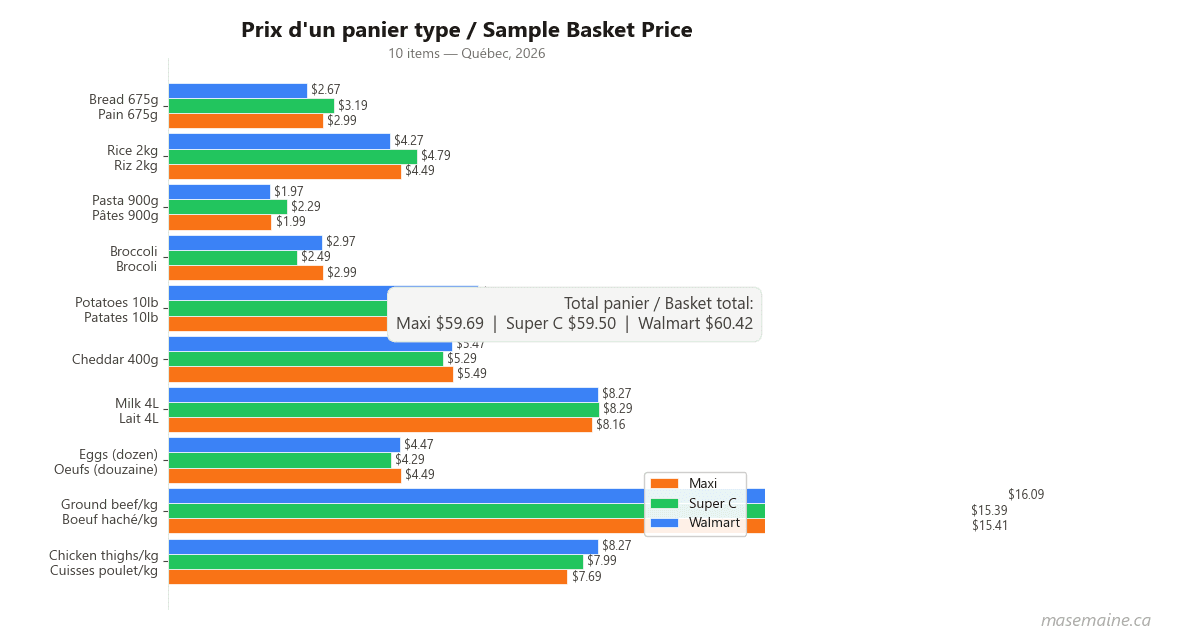
Every Quebec shopper has a strong opinion about which grocery store is cheapest. Some swear by Maxi. Others say Super C is the real deal. And then there are the Walmart loyalists who insist that price matching and everyday low prices make it unbeatable.
So who is actually right? We decided to compare prices on over 30 common grocery items across all three stores to find out.
The short answer: it depends on what you buy, when you buy it, and whether you pay attention to weekly deals. But the data tells a much more interesting story than "they're all about the same."
At a glance: who wins what
No single chain wins across the board. Quebec families who save the most plan meals around the weekly flyer — and that can mean $100-$150/month in savings. Here's the data behind each category.
A note on methodology
We tracked regular shelf prices and flyer deal prices across Maxi, Super C, and Walmart locations in the Greater Montreal area over several weeks in early 2026, cross-referencing retailer websites (maxi.ca, superc.ca, walmart.ca), weekly flyers, and in-store observations. Prices vary by location, week, and season — so treat these as representative comparisons, not guarantees of what you'll find on your next trip.
All prices are in Canadian dollars. We compared identical or equivalent products (same brand and size when possible, store brand equivalents otherwise). Protein prices are for regular or club pack formats, boneless skinless for breasts.
Protein prices: chicken, beef, and eggs
Proteins are typically the most expensive items on any grocery list, so even small price differences add up quickly over a month.
Protein winner: Maxi and Super C are neck and neck. Maxi tends to edge out on chicken, while Super C often has a slight advantage on ground beef and eggs. Walmart is competitive on turkey but consistently a few cents to a dollar higher on the staples. The real game-changer is weekly flyer deals — Maxi regularly drops chicken breast to $7.69/kg or even $6.59/kg as a loss leader, which blows away both competitors' regular prices. And beyond price per kilo, nutrient density per dollar makes chicken thighs a better investment than breasts.
Dairy prices: milk, cheese, yogurt
Dairy is one of the most price-regulated categories in Canada, so differences tend to be smaller — but they still exist.
Dairy winner: Essentially a three-way tie. Walmart's "always two cents less" pricing strategy is visible here — they consistently undercut by $0.02 to $0.03, but it barely matters. The real savings come from catching dairy on sale. Maxi and Super C both regularly put cheese at 40-50% off in their weekly flyers.
Produce prices: fruits and vegetables
Produce is where prices fluctuate the most from week to week. These are typical regular-price comparisons.
Produce winner: Super C. This is Super C's strongest category. They consistently undercut Maxi and Walmart on fresh vegetables by $0.20 to $0.50 per item. For a family buying 8-10 produce items per week, that's $2 to $5 in savings on produce alone. Maxi, however, regularly offers aggressive produce deals in their flyer — you'll often see 3lb bags of apples at $2.49 or broccoli crowns at $1.49.
Pantry staples: pasta, rice, canned goods
These items form the backbone of budget cooking. Small differences here compound over months.
Pantry winner: Walmart. This is where Walmart's model shines. On shelf-stable staples that don't go on sale as frequently, Walmart's everyday pricing consistently beats both discount grocers by $0.20 to $0.50 per item. Peanut butter, oil, rice, and bread are notably cheaper. Over a month, a family that buys 15-20 pantry items could save $5-$10 here.
The real scorecard
If you shop at a single store every week:
- Super C gives the most consistent low prices across all categories without requiring flyer-watching. Your bill will be predictably lower, especially on produce and meat.
- Maxi has higher regular prices on some items but offers the most aggressive weekly deals in Quebec. If you plan your meals around the flyer, Maxi can be the cheapest option by a wide margin on deal weeks.
- Walmart wins on pantry staples and offers reliable, consistent pricing. Their ad match policy (where available) means you can theoretically get other stores' deal prices without driving to multiple locations.
The honest answer: no single store is always cheapest
If you always shop at Maxi, you'll overpay on produce most weeks. If you only shop at Super C, you'll miss Maxi's loss-leader protein deals. If you stick to Walmart, you'll get fair prices on everything but rarely the best price on anything perishable.
The shoppers who save the most in Quebec do one of three things:
- Shop two stores — typically a discount grocer (Maxi or Super C) for proteins and produce, plus Walmart for pantry staples. This can save $15-$27/week compared to single-store shopping.
- Plan meals around the weekly flyer — especially Maxi's. If chicken thighs are $5.49/kg this week, you cook chicken dishes. If pork is on deep discount, you pivot. This approach alone can save $20-$30/week.
- Use Walmart's ad match policy — bring competitor flyers (or screenshots) and get the deal price at Walmart. Not all locations enforce it the same way, but when it works, it saves you a second trip.
The problem with all three strategies? They take time. Comparing flyers, planning meals, and adjusting your grocery list every week is a 30-60 minute task that most families skip.
How to actually save without the hassle
The biggest savings in Quebec grocery shopping don't come from loyalty to one store. They come from planning your meals around what's on sale this week — and then buying only what you need for those meals.
This is the approach that saves the most money and reduces the most waste, but it's also the hardest to do manually. You need to:
- Check 3-4 flyers every week
- Cross-reference deals against recipes you actually want to cook
- Build a grocery list that uses sale items efficiently (no buying 2kg of discounted chicken with no plan for it)
- Stick to the list at the store
When families do this consistently, the savings are significant: $100-$150/month compared to habitual same-store shopping.
How to actually do this every week (without willpower)
Comparing flyers from Maxi, Super C, and Walmart by hand is a 30-60 minute job. MaSemaine automates the three steps that make meal planning stick long-term:
Step 1: Your week is planned automatically
You pick what you like, the number of people, and how many meals. The AI generates a complete meal plan for the week — based on your tastes, not a price chart. The result: a calendar with all your meals, ready in minutes.
Step 2: Deals from Maxi, Super C, and Walmart are matched automatically
The app reads flyers from 7 Quebec chains every Thursday. When chicken thighs are $5.49/kg at Maxi instead of $7.99 at Super C, your recipes adjust. No more comparing flyers yourself.
Step 3: Your grocery list shows the best price per store
Every item shows the current price at each store. No more guessing where to go — the list tells you whether chicken breasts are cheaper at Maxi or Super C this week.
Frequently asked questions
Is Maxi cheaper than Super C in Quebec?
It depends on the category and the week. Maxi tends to offer more aggressive weekly deals, especially on proteins like chicken and pork. Super C has more consistently low regular prices on produce and some pantry items. For a typical mixed basket, the two stores are within 2-3% of each other on non-sale items.
Does Walmart price match in Quebec?
Walmart Canada's ad match policy allows you to match a competitor's advertised price on identical items at checkout. However, enforcement varies by location and cashier. Some Quebec Walmart locations are strict about requiring the physical flyer, while others accept the Flipp app. It's worth asking at your local store.
How much can you save by shopping at discount grocery stores in Quebec?
Compared to full-service grocers like Metro or IGA, shopping at Maxi, Super C, or Walmart can save a typical Quebec family $40-$80/month on a comparable basket. The savings increase further if you plan meals around weekly deals, potentially reaching $100-$150/month in total savings.
Is it worth driving to multiple stores to save money on groceries?
Only if the stores are close together and the savings are significant. Driving 15 minutes out of your way to save $3 on chicken rarely makes sense when you factor in gas and time. The better strategy is to pick the store that wins for most of your list, then use ad matching at Walmart or plan meals around one store's best deals each week.
Are store brands really cheaper than national brands?
Yes — by 20-40% on average in Quebec. No Name (Maxi/Provigo), Selection (Metro), and Great Value (Walmart) offer significant savings on pantry staples, canned goods, and dairy. Quality varies by product, but for basic ingredients (flour, pasta, canned tomatoes, plain yogurt), the taste difference is often imperceptible. The real comparison to make: Super C's store brand vs Maxi's vs Great Value — and there, prices vary by category.
When do weekly flyers come out in Quebec?
Most major chains publish new flyers on Thursday. Maxi, Super C, Metro, IGA, Provigo, and Walmart update their weekly deals at that time. Flyers are valid for one week (Thursday to the following Wednesday). Checking flyers Thursday evening or Friday morning gives you the most time to plan meals around the best deals before doing your Saturday grocery run.
Are Metro and IGA really more expensive than Maxi and Super C?
On average, yes — by 10-20% on a comparable basket. Metro and IGA are full-service grocers with wider selections, deli and butcher counters, and more imported products. You pay for that convenience. That said, their flyers sometimes offer competitive deals on targeted items. The optimal strategy isn't to avoid them entirely, but to not do all your shopping there every week.
References
- Statistics Canada. (2023). Survey of Household Spending, Table 11-10-0222-01 — Average food expenditure by province. https://www150.statcan.gc.ca/
- Canada's Food Price Report 2026. Dalhousie University et al. Food inflation forecasts by category in Canada. https://www.dal.ca/sites/agri-food/research/canada-s-food-price-report-2026.html
- Competition Bureau Canada. (2023). Market Study — Competition in Canada's Grocery Sector. https://www.competitionbureau.gc.ca/
Read more: