How to Find the Best Grocery Deals in Quebec Every Week
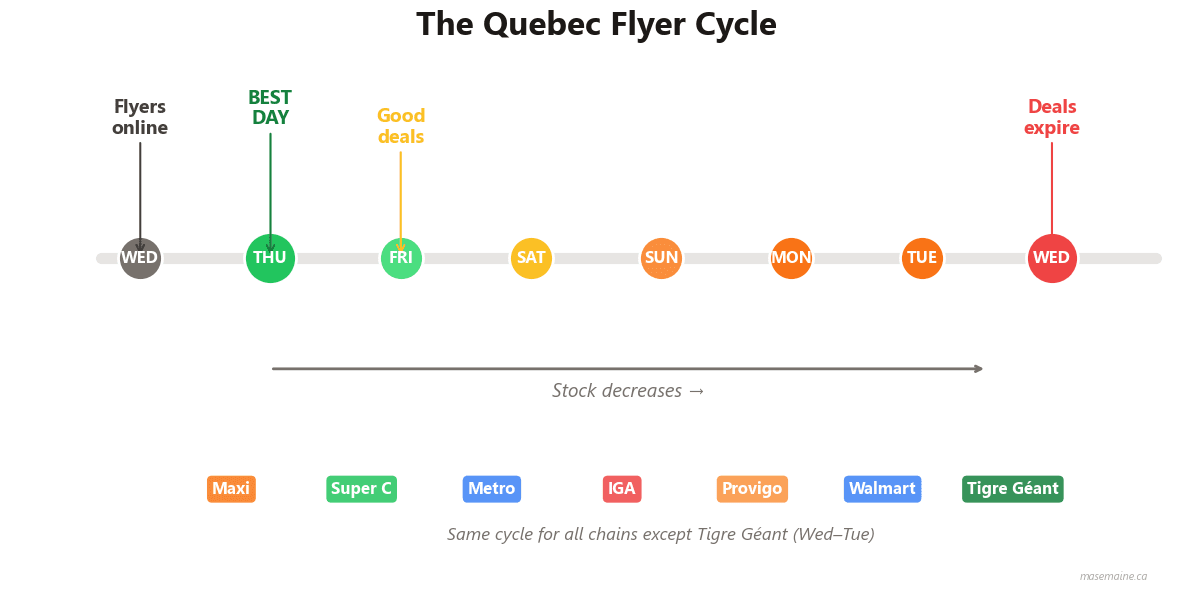
Every Thursday, the grocery landscape in Quebec resets. New flyers drop from Maxi, Metro, IGA, Super C, Provigo, Walmart, and Tigre Geant — hundreds of new prices, dozens of genuine bargains, and a few outstanding loss leaders designed to get you through the door.
Most people know this. Far fewer know how to actually work the system. The difference between a shopper who "checks the flyers" and one who consistently saves $150+ a month comes down to method, not effort. It's about knowing which deals are real, which are traps, and how to turn the good ones into meals your family will eat.
This guide gives you the data, the price thresholds, and the system.
When deals drop: the Thursday reset
Quebec grocery flyers run on a Thursday-to-Wednesday cycle. New circulaires go live on Thursday morning, and the deals are valid for exactly one week. This is consistent across most major chains — the one exception is Tigre Geant, whose flyer runs Wednesday to Tuesday.
Why Thursday matters: The most aggressive loss leaders are freshest on Thursday. By Saturday or Sunday, the best items — especially meat and produce at steep discounts — can be sold out at popular locations. If you can shop Thursday or Friday, you get first pick.
When to actually look at flyers: Wednesday evening or Thursday morning. The new flyers are usually available online by Wednesday night. This gives you time to plan before you shop.
Where to find them: Every chain publishes digital flyers on their website and app. Aggregator apps like Flipp compile them in one place. MaSemaine reads them automatically and uses the data to generate meal plans — but more on that later.
Know your chains
Not all Quebec grocery chains compete the same way. Here's how they stack up:
The key insight: Maxi and Super C have the lowest everyday prices, but any chain can win on a given week's loss leaders. Metro and IGA have higher regular prices but discount more steeply to create contrast. Walmart rarely has the best deal, but their regular price sometimes beats other stores' sale price on pantry items.
The deal reference card: know your prices
The biggest advantage you can have at the grocery store is knowing what a good price looks like before you see the flyer. Bookmark this section — these thresholds are based on real Quebec prices tracked across chains in early 2026.
How to use this: When you see chicken thighs at $5.49/kg in a flyer — that's a great deal, buy it and plan meals around it. Chicken thighs at $7.99/kg? Good — buy it if you need it, but it's not worth reorganizing your week. Over $8? Skip it — wait for a better week or pick a different protein.
When to buy what: the seasonal calendar
Quebec grocery prices follow predictable seasonal patterns. Buying in sync with these cycles compounds your savings over the year.
The pattern: Produce is cheapest when it's local and in season (June–September). Proteins follow holiday cycles — turkey at Thanksgiving, ham at Easter, ground beef in May. Pantry staples go on sale when stores need foot traffic in slow months (January, February).
How to read a flyer like a pro
A flyer is a marketing document. Its job is to get you into the store. Understanding the layout helps you separate genuine savings from psychological tricks.
Front page = loss leaders. The items on the first page are almost always sold at or below cost. The store loses money on these products to create foot traffic. These are your best deals. Build your shopping around them.
Pages 2–3 = solid deals with margin. These are real discounts but the store is still making money. Worth buying if you need them, but don't go out of your way.
Back pages = filler. Small discounts on products with high margins. A $0.50 discount on a $6.99 bag of chips is not a deal — it's a reminder that chips exist.
"Save up to" language = red flag. When a flyer says "save up to $3," the actual savings on most items in that grouping is $0.50–$1.00. The $3 saving applies to one specific item buried in the fine print.
Per-unit math matters. A "2 for $5" deal sounds good, but if the regular price is $2.79, you're saving $0.58 total. Always do the per-kilogram calculation. Some "deals" save you less than a quarter.
Should I buy this deal?
The most important skill in deal-hunting isn't finding deals — it's knowing when to skip them. Buying something you don't need because it's on sale is not saving money. It's spending money you wouldn't have spent. A $10 weekly increase in impulse "deal" purchases adds up to $520 a year.
The deal trap is worst with: perishable "buy 2 get 1" offers you can't eat fast enough, snacks and treats (the margin is so high that even "50% off" is profitable for the store), and unfamiliar products you're trying just because they're cheap.
One week, two ways: the math
Here's what the same week of groceries costs for a family of four — once planned around flyer deals, once without. Prices are from real Quebec flyers and shelf prices in early 2026.
Planned around deals
You checked the flyers Thursday morning. Super C has chicken thighs at a loss-leader price. Maxi has ground beef and pork on deal. You built 5 dinners around these proteins.
No planning, one conventional store
You drove to Metro after work. No list, no flyer check. You bought what looked good at regular prices, plus a couple of impulse grabs near the checkout.
The difference
The savings come from three places: buying proteins at their lowest weekly price instead of regular, shopping at discount chains instead of conventional, and eliminating impulse purchases because you arrived with a plan.
What the research says
These numbers aren't surprising when you look at the literature. A 2009 study in the Journal of Marketing found that roughly 60% of grocery purchases involve some decision made in-store — not at home with a list [1]. Research by Stilley et al. (2010) in the Journal of Consumer Research shows that shoppers who arrive with flexible budgets consistently overspend, and the gap grows with time spent in the store [2].
On the flip side, a large-scale French study in the International Journal of Behavioral Nutrition and Physical Activity found that meal planning is associated with better diet quality and lower food spending — both at the same time [3].
The takeaway: arriving with a plan reduces in-store decisions, and fewer in-store decisions means less unplanned spending.
Digital vs. paper flyers
Paper flyers still arrive in Quebec mailboxes, but digital is better for deal hunting:
- Search: You can search "chicken" across all stores instantly. Paper requires flipping through 7 flyers manually.
- Timing: Digital flyers appear Wednesday evening. Paper arrives Thursday or Friday — sometimes too late for the best items.
- Comparison: Aggregator apps show the same item across stores side by side.
- History: Some digital tools track whether a "sale price" is actually lower than last month's sale price.
The downside of digital: it's easier to browse endlessly. Set a time limit. Fifteen minutes is enough to identify the week's best deals.
How to Actually Do This Every Week (Without Willpower)
The process described in this article — scanning flyers, spotting good deals, building meals around them, writing a grocery list — works. But it takes 30–45 minutes a week and discipline. Here's how MaSemaine automates all three steps.
1. You pick your preferences, not a diet
You tell the app how many people eat, your dietary preferences, your budget, and how much time you want to spend cooking. Nobody forces you to eat lentils if you don't like lentils.
2. Deals are matched automatically
The app reads flyers from 7 chains every Thursday and identifies the best prices. When chicken thighs are $4.30/kg at Maxi instead of $8.97 at Metro, your recipes adjust.
3. Your grocery list is ready, organized by aisle
No more scribbled list on a scrap of paper. Every ingredient is grouped by store section with prices — no more backtracking and no impulse grabs near checkout.
Frequently Asked Questions
What is a loss leader, and how do I spot one? A loss leader is an item sold below the store's cost to generate foot traffic. They're almost always on the front page of the flyer and priced well into the "great deal" zone of the reference card above. The store bets you'll also buy $40 of regular-price items. Your job: take the loss leader, skip the bait around it.
Do loss leader prices vary between locations of the same chain? Prices in the flyer are generally consistent across all locations of a chain in Quebec. However, stock levels vary — popular locations sell out of loss leaders faster. If you want the best selection, shop Thursday or Friday morning.
Can I price match loss leaders at another store? Maxi offers price matching on competitors' flyer prices (up to 4 items per transaction). IGA matches and beats by 1 cent on items tagged "Unbeatable Price." Metro and Super C do not price match. Walmart discontinued competitor price matching in 2020.
How do PC Optimum points stack with Maxi flyer deals? They stack fully. If Maxi has chicken thighs at $5.49/kg in the flyer AND you have a targeted PC Optimum offer for bonus points on chicken, you get both. Check your personalized offers in the app before shopping — targeted offers can add an effective 5–15% discount on top of flyer prices.
How much time does flyer-based meal planning take? Manually: 30–45 minutes per week (scanning flyers, choosing recipes, writing a list). With an app like MaSemaine that reads flyers automatically: under 5 minutes to review and adjust the generated plan.
References
- Inman, J. J., Winer, R. S., & Ferraro, R. (2009). The Interplay Among Category Characteristics, Customer Characteristics, and Customer Activities on In-Store Decision Making. Journal of Marketing, 73(5), 19–29. doi:10.1509/jmkg.73.5.19
- Stilley, K. M., Inman, J. J., & Wakefield, K. L. (2010). Planning to Make Unplanned Purchases? The Role of In-Store Slack in Budget Deviation. Journal of Consumer Research, 37(2), 264–278. doi:10.1086/651567
- Ducrot, P., et al. (2017). Meal planning is associated with food variety, diet quality and body weight status in a large sample of French adults. International Journal of Behavioral Nutrition and Physical Activity, 14, 12. doi:10.1186/s12966-017-0461-7
Read more:
- Am I overpaying? Compare Quebec grocery prices in 5 seconds
- 10 Foods That Got Most Expensive in Canada in 2026 (and What to Buy Instead)
- Maxi vs Super C vs Walmart: Which Is Cheapest?
- How Much Canadians Spend on Groceries
- Flipp vs Grocery Flyer Apps in Canada
- Why Cheap Food Costs You More: The Nutrient Density Guide
- How to Eat Well on $75/Week in Quebec
- Grocery List by Aisle — Free Template