The Cheapest Foods Are Also the Best for Weight Loss
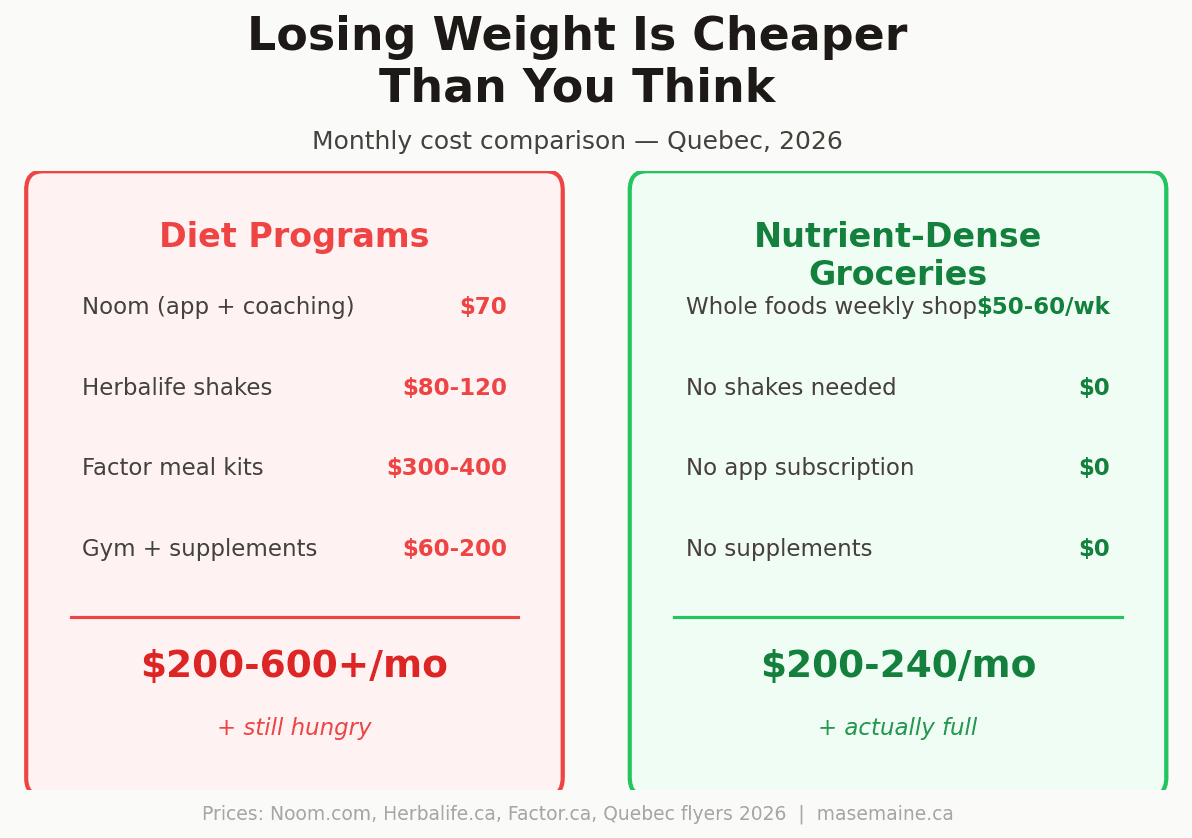
You're paying $70/month for Noom. Another $90 on Herbalife shakes. Maybe $60 for the gym. That's $220/month before you even buy groceries — and you're still hungry at 9 PM, reaching for chips because the shake at lunch didn't hold you.
Meanwhile, the foods with the strongest scientific evidence for weight loss — lentils, eggs, potatoes, chicken breast, frozen vegetables — cost under $3/kg at any Quebec grocery store. No subscription. No shakes. No app telling you to log your feelings.
The diet industry sells you willpower management. The science says the problem was never willpower — it was the food itself.
What the Diet Industry Actually Sells You
The weight loss market runs on a simple model: charge a monthly fee for something your grocery store already provides. Here's what it costs in 2026:
Noom charges ~$70/month for an app that tracks your food and sends coaching messages. It doesn't provide food. Herbalife sells meal replacement shakes at $80–120/month — powdered protein that you mix with water instead of eating a real meal. Factor delivers pre-made "healthy" meals at $300–400/month for one person. Add a gym membership ($30–60/month) and supplements ($30–80/month) and a typical "diet lifestyle" runs $200–600+/month.
What do all these products have in common? They work around the problem instead of solving it. The problem isn't that you lack coaching or protein powder. The problem is that ultra-processed food doesn't satisfy you — your body keeps eating because its protein and nutrient targets aren't being met. No amount of Herbalife shakes will fix a diet built on food your body can't use efficiently.
What if you spent that $260/month on groceries instead? That's $65/week — more than enough for nutrient-dense eating in Quebec. You'd get real food that actually fills you up, better scientific evidence behind the approach, and $200–400/month back in your pocket. The catch? There is no catch. The research is clear, and it comes from the highest level of evidence we have.
The NIH Study That Changes Everything
In 2019, researcher Kevin Hall ran the most rigorous diet study ever conducted. Twenty adults lived at the National Institutes of Health for 28 days. All food was provided. They could eat as much as they wanted, whenever they wanted. The only variable: for two weeks they ate an ultra-processed diet, and for two weeks they ate an unprocessed whole-food diet. Both diets were matched for calories, sugar, fat, fiber, and protein available.
The results were striking.
On the ultra-processed diet, people ate 500 more calories per day without realizing it and gained 0.9 kg in two weeks. On the whole-food diet, they naturally ate less and lost 0.9 kg. Nobody counted calories. Nobody tried to restrict. The food itself determined how much they ate.
The detail that made headlines: on the ultra-processed diet, participants ate 17 calories per minute — roughly twice the rate they ate on the whole-food diet. The food was engineered to be eaten fast. Ultra-processed food is softer, requires less chewing, and reaches your bloodstream before your gut has time to signal fullness. The satiety hormones — particularly GLP-1 and PYY — need roughly 20 minutes after eating begins to register. Ultra-processed food is specifically designed to get as many calories into you as possible before that signal arrives.
A 1.8 kg swing in two weeks — just from changing what the food was made of. The 2025 Lancet series on ultra-processed food (3 papers, 100+ studies) confirmed what Hall's study showed in controlled conditions: UPF causes adverse outcomes across nearly all organ systems. This isn't fringe science. It's the current consensus.
And in Canada, 46% of daily calories come from ultra-processed food. For children, it's over 50%. One in three Canadian adults is now obese — up from one in four pre-pandemic. In Quebec specifically, the obesity rate sits at roughly 29%. The connection between these numbers is not coincidental.
The Protein Quota Your Body Won't Ignore
Why does ultra-processed food make you overeat? The answer is protein leverage — a mechanism identified by researchers Simpson and Raubenheimer that explains why willpower fails against bad food.
Here's the simplest way to understand it: your body treats protein like a to-do list item that has to get checked off. If dinner was low-protein, you'll keep snacking until the box is ticked — eating carbs and fat that you didn't need along the way. Your body will push you to eat until you hit roughly 15% of your calories from protein, regardless of how many total calories that takes.
The data backs this up. Among the highest consumers of ultra-processed food, 73.3% eat less than 15% of their calories from protein. Among the lowest UPF consumers, only 25.1% fall below that threshold. Every 14 percentage-point increase in ultra-processed food share corresponds to a 1 percentage-point drop in protein density. The math is simple: UPF is engineered to be low-protein (it's cheaper to manufacture), so you eat more of it to hit your body's protein target.
The fix is equally simple. Eat foods that hit the protein target early in the meal, and your body stops asking for more. One caution on what "the protein target" means if you have a lot to lose: it is calculated on lean body mass, not total bodyweight. Scaling protein to total mass in obesity overshoots badly — the difference is roughly 227 g/day versus 118–190 g/day for the same person, and the higher figure is the one people quit over. I worked that calculation through in the carbohydrate timing article. The cheapest high-protein foods in Quebec? Dried lentils at $0.24 per 30g protein. Eggs at $0.63. Chicken breast at $1.50. Meanwhile, a serving of Herbalife shake costs $3.00–4.00 for the same 30g of protein.
A month of Herbalife shakes ($80–120) buys 35 kg of dried lentils — enough protein for two people for two months.
The Natural Ozempic Your Gut Already Makes
You've heard of Ozempic and Wegovy — the GLP-1 receptor agonist drugs that are reshaping weight loss treatment. What most coverage doesn't mention: GLP-1 (glucagon-like peptide-1) is a hormone your body already produces naturally after eating protein and fiber. It signals satiety, slows digestion, and suppresses appetite. The drugs work by mimicking it artificially because most people's diets have been so stripped of protein and fiber that the natural GLP-1 response is chronically blunted.
The irony: the same foods that trigger robust natural GLP-1 release — legumes, eggs, oats, vegetables — are the cheapest items in any Quebec grocery store. Dried lentils at $2.60/kg trigger a stronger and more sustained GLP-1 response than a bag of chips. Potatoes trigger a more powerful GLP-1 response than potato chips made from the same potato. The processing — removing fiber, adding refined starch and seed oils — specifically strips out the components that activate your satiety hormones.
Semaglutide (Ozempic) costs approximately $300–400/month in Canada. A weekly shop of high-fiber, high-protein whole foods costs $50–60/week. Both approaches activate the same biological pathway. One works because of what it contains. The other works despite what you're eating.
Your Carbohydrate Is Already a Protein Decision
Here is the lever this article has historically undersold, and it is the one that costs nothing.
Protein is not something you add to a plate from the meat counter. Every staple carbohydrate you eat already carries protein — the spread between them is just enormous, and nobody points at it. You are spending those calories either way. The only question is whether they show up with protein attached.
Lentils (dry) 7.0 g protein per 100 kcal
Oats 4.3 g
Buckwheat 3.9 g
Quinoa 3.8 g
Pasta (dry) 3.5 g
White bread 3.4 g
White rice (dry) 2.0 g
Calculated from USDA FoodData Central. Lentils deliver three and a half times the protein of white rice for the same calories.
Put a number on it. Say 800 kcal of your day comes from a starchy staple, which is unremarkable:
800 kcal of white rice 15.6 g protein
800 kcal of lentils 56.0 g protein
+40 g of protein, for exactly the same calories
No extra food. No extra money — lentils run $2.60–3.20/kg. The same plate, filled differently.
Forty grams is not a rounding error. That is the difference between hitting a protein target and missing it, and it arrives without adding a single calorie or a single dollar. Most weight-loss advice tells you to add protein — buy chicken, buy shakes, buy powder. The cheaper move is to stop spending calories on carbohydrate that brings none.
This also reframes the protein leverage mechanism above. If your body keeps eating until the protein box is ticked, then a plate built on white rice and white bread is a plate that will keep you eating — not because you lack discipline, but because you have not yet given it what it is looking for.
The practical version
Lentils instead of rice. Oats instead of cereal. Buckwheat or quinoa instead of plain pasta.
You are not eating more. You are eating the same amount of the version that counts.
But isn't fibre more important than protein for feeling full?
It is a fair challenge, and the honest answer is that neither wins outright — they do different jobs, and in these foods you are not asked to choose.
Where fibre has the stronger case. Energy density is the single biggest driver of how much you eat at one sitting, which is the volumetrics argument below. And there is a striking trial behind the simplicity: Ma and colleagues randomised people either to the full American Heart Association diet or to a single instruction — eat 30 g of fibre a day — and got comparable weight loss from both [18]. One rule people actually follow beats twelve they abandon.
Where protein has the stronger case. Protein does one thing fibre cannot: it protects lean mass while you are in a deficit. That matters directly for the arithmetic above — a smaller body burns less, and if the weight you lose includes muscle, your basal rate falls further and the plateau arrives sooner. Fibre has no equivalent of the protein quota either; nothing makes your body keep eating until it has hit its fibre target.
And then the question mostly dissolves, because in this food set the two travel together:
Per 100 g dry Protein Fibre
Lentils (dry) 24.6 g 10.7 g
Oats 16.9 g 10.6 g
Buckwheat 13.3 g 10.0 g
Quinoa 14.1 g 7.0 g
Pasta (dry) 13.0 g 3.2 g
White bread 8.9 g 2.7 g
White rice 7.1 g 1.3 g
Rank these by protein and rank them by fibre and you get almost the same list. The swap that buys one buys the other.
The foods at the top are top on both counts. The foods at the bottom are bottom on both. So the practical answer to "should I prioritise fibre or protein" is that the plate does not make you decide — the same substitution moves both numbers at once.
The one real asymmetry is worth knowing: fibre has a tolerance ceiling and protein, within reason, does not. You can keep raising protein long after your gut has stopped enjoying more lentils. If you are stacking legumes and whole grains and feeling heavy and bloated rather than satisfied, fibre has become the binding constraint — and at that point the next increment should be protein, not more bran.
The Paradox: Eat More Food, Lose More Weight
If protein leverage explains why you overeat, volumetrics explains why you don't have to feel hungry while fixing it.
Barbara Rolls' research (1-year RCT, 71 obese women) found that the group eating more food by weight — specifically more fruits and vegetables — lost 7.9 kg vs. 6.4 kg for the group that just reduced fat. They ate 225g more food per day but consumed 500 fewer calories. Hunger scores were significantly lower.
The mechanism is energy density. Foods with a lot of water and fiber (vegetables, fruits, legumes, potatoes) fill your stomach physically while delivering relatively few calories per gram. The cheapest foods in Quebec happen to be exactly these foods.
Fiber plays a dual role that calorie labels miss entirely. First, it physically slows the movement of food through your digestive tract, giving satiety hormones time to activate before you've overeaten. Second, soluble fiber (abundant in oats, lentils, and apples) ferments in your colon, feeding bacteria that produce short-chain fatty acids — which independently signal the brain to reduce appetite. High-fiber meals don't just fill you up temporarily; they alter the hormonal environment for the next 4–6 hours. This is why a bowl of oatmeal at 7 AM is still protecting you from overeating at 11 AM, while a croissant at the same calorie count has no such effect.
Look at the pattern: broccoli at 34 kcal/100g costs $1.50 per crown. Potatoes at 77 kcal/100g cost $0.44–0.87/kg — and have the highest satiety index of any food ever tested. Lentils, eggs, Greek yogurt — all under 150 kcal/100g, all highly satiating, all under $4 per unit at Quebec stores.
Now look at the other end: chips at 536 kcal/100g, granola bars at 470 kcal/100g. These are the foods you reach for at 9 PM after an unsatisfying dinner. They're calorie-dense, they don't fill you up, and they cost more per unit of satiety than the whole foods that would have prevented the craving in the first place.
The cheapest way to lose weight in Quebec is literally to eat more potatoes, more lentils, more frozen vegetables, and more eggs. Not fewer calories — better calories.
The Math: What 500 Fewer Calories Per Day Actually Means
The Hall study showed people naturally ate 500 fewer calories per day on whole foods. Let's translate that number into real terms.
One kilogram of body fat contains approximately 7,700 kcal of stored energy. At a 500 kcal/day deficit — which the Hall participants achieved without trying — you burn through that store at roughly 0.45 kg per week, or 1.8 kg per month.
Do not extrapolate that to a year. It is tempting to multiply out to 22 kg and it is wrong, for a reason worth understanding: the arithmetic assumes your body stays the same size while you shrink it. It does not. A lighter body has a lower basal metabolic rate and spends less energy moving itself around, so the same behavioural change buys progressively less deficit as you go. Kevin Hall — the same researcher whose whole-food study this article is built on — published the dynamic model that quantifies this, and it shows the fixed-calories-per-kilogram rule substantially overestimates long-run loss [15].
The honest version: expect the first months to look roughly like the arithmetic above, and expect the curve to flatten. That is not failure. That is a smaller body needing less food, which is the thing you were trying to achieve.
The critical distinction: a 500 kcal deficit achieved by eating less is miserable and unsustainable, and there is a mechanism behind that rather than a character flaw. Leptin is the hormone fat tissue uses to tell the brain it has enough stored, and it reaches the brain through a saturable transporter across the blood-brain barrier. In obesity, blood leptin runs high while the brain behaves as though it were low. Why that happens is genuinely disputed — one line of work points at impaired transport across the barrier [16], another traces transport directly and finds it intact, putting the fault downstream in receptor signalling [17]. The phenomenon is not in doubt; the location of the fault is. Either way the consequence is the same: the same deficit is hungrier for someone with more to lose. A 500 kcal deficit achieved by switching food types is invisible, because the whole-food meals fill you up just as much — or more. This is what Rolls' volumetrics research proved: you can eat the same volume of food and consume 500 fewer calories, simply by choosing foods with lower energy density.
Ultra-processed food delivers that deficit in reverse: it makes you eat 500 extra calories per day while feeling less full. Whole food creates the same 500-calorie swing in the beneficial direction — and the price difference between the two approaches at a Quebec grocery store is negative. The food that helps you lose weight costs less.
The 10 Cheapest Weight-Loss Foods at Quebec Grocery Stores
Every food on this list is available year-round at Maxi, Super C, Walmart, Metro, and IGA. No specialty stores required, no seasonal availability issues. These are the 10 foods with the best intersection of low price, high satiety, and strong weight-loss evidence.
Dried lentils ($2.60–3.20/kg) are the undisputed champion. One cooked cup delivers 9g of protein plus 8g of fiber — the combination that keeps you full for 4+ hours. Red lentils cook in 15 minutes without soaking. At this price, a serving costs under $0.25.
Oats ($3.49/kg in large format) score the highest satiety index of any breakfast food. A single serving costs $0.12 and keeps you full until lunch. Buy the large-format bags at Maxi or Walmart — the per-gram cost drops by 30–40% versus small boxes.
Eggs ($9.78 per 30-pack at Walmart) provide complete protein — 13g per two eggs — and cook in under 5 minutes. At $0.33 per egg, this is the cheapest complete protein source after lentils.
Potatoes ($0.44–0.87/kg in 10lb bags) have the highest satiety index of any food ever tested — 323, compared to 100 for white bread. A baked potato with Greek yogurt on top is a complete, filling meal for under $1.
Frozen vegetables ($2.44–3.99/bag) let you fill your plate for under $1. Nutritionally equivalent to fresh — sometimes better, since they're frozen within hours of harvest. Mixed stir-fry bags are the fastest dinner shortcut that exists.
Chicken thighs ($4.30–5.99/kg on sale) deliver 26g of protein per serving. Buy bone-in on sale, cook a sheet pan on Sunday, and you have protein for 4–5 meals. Bone-in thighs are the best value cut — more flavour and 30–40% cheaper than breast.
Greek yogurt ($6.47/650g) provides 10g of protein per 100g — the most cost-effective dairy protein. Use it as a topping on potatoes, mix with oats, or eat it plain as a snack. It replaces sour cream in almost any recipe.
Canned tuna ($0.99–1.67/can) gives you 20g of protein per can with zero prep time. Keep a dozen cans in the pantry. Tuna on toast with a side of frozen vegetables is a complete meal in 5 minutes for under $3.
Cabbage ($1.08–1.74/kg at Maxi/Super C) is the most underrated vegetable in Quebec. At 25 kcal per 100g, you can eat an enormous serving for under $0.50. Coleslaw, stir-fry, soup — one head lasts a week and fills half your plate at almost zero calorie cost.
Frozen spinach ($2.49/300g) has an ANDI nutrient density score of 707 — one of the highest of any food. Add it to eggs, pasta, soup, smoothies. It's invisible in most dishes but adds iron, folate, and vitamins A and K to every meal.
The True Cost Comparison
Let's put the full picture together. Here's what a month actually costs under each approach:
The "diet lifestyle": Noom ($70) + Herbalife shakes ($100) + gym ($50) + supplements ($40) = $260/month minimum — and you still need to buy groceries on top of that. Realistically, $400–600/month total food + program cost for one person.
Whole foods from Quebec stores: A weekly shop built around lentils, eggs, chicken breast on sale, potatoes, frozen vegetables, oats, and Greek yogurt runs $50–60/week — roughly $200–240/month. No subscriptions. No shakes. No supplements. And the food actually satisfies you, so you're not ordering Uber Eats at 9 PM.
The savings: $200–400/month — and the whole-food approach has better evidence behind it than any commercial diet program on the market.
That $5,720/year in savings is not theoretical — it's the gap between paying for programs that don't address the real problem and buying food that does. For context on how to hit $75/week or less, see our complete guide to eating well on $75/week in Quebec.
If you want to understand why the cheapest foods per kilogram aren't actually the cheapest foods per unit of nutrition, the nutrient density guide breaks down the math in detail.
How to Make It Happen Without Planning Everything by Hand
Everything above works — but only if you actually build meals around these foods every week. That's where it falls apart for most people. Not because they lack knowledge, but because Wednesday night hits and you're too tired to figure out what to cook with lentils and frozen broccoli.
MaSemaine automates the three steps that make this stick:
Step 1: Set your preferences — no willpower required
You tell the app what you like, how many people you're feeding, and any dietary restrictions. The AI builds a week of recipes around nutrient-dense whole foods — but foods your family will actually eat. Nobody forces you to eat lentils if you hate lentils.
Step 2: This week's deals rotate in the cheapest proteins
The app reads flyers from Maxi, Super C, Metro, IGA, Provigo, Walmart, and Tigre Geant every Thursday. When chicken breast is $4.99/lb at Maxi instead of $7.99 at Metro, your recipes adjust. The nutrient-dense foods that help you lose weight become even cheaper when they're on sale — and the app catches deals you'd miss.
Step 3: Your grocery list keeps you out of the chip aisle
A structured list organized by store section means you walk in, get what you need, and leave. No wandering. No impulse buys. Every item shows the current price at each store. For more on why this matters, see our grocery list by aisle template.
Frequently Asked Questions
But healthy food IS more expensive per calorie — isn't this misleading? Per calorie, yes. Chips deliver about 536 kcal per 100g for ~$1.50/100g. Broccoli delivers 34 kcal for a similar price per weight. But calories aren't the metric that matters for weight loss or your wallet. The metric that matters is cost per unit of satiety — how much it costs to actually feel full and stay full. A $1.50 crown of broccoli plus two eggs ($0.65) plus a cup of rice ($0.30) makes a complete, satisfying meal for $2.45. A bag of chips leaves you hungry an hour later and reaching for more. When you add up the real weekly cost — groceries plus snacks plus takeout triggered by unsatisfying meals — whole foods consistently come out ahead by $30–50/week.
What's the first change I should make? Replace your current breakfast with oats and eggs. This single change costs under $1.50 per morning and delivers 20+ grams of protein before 9 AM. Most people who eat a high-protein breakfast find their 10 AM snack craving disappears completely. That's one fewer trip to the vending machine or coffee shop — which alone saves $3–5/day ($60–100/month). Start here, see the difference after one week, then tackle lunch and dinner.
What if I don't have time to cook? The highest-impact change takes 10 minutes: scramble three eggs with frozen vegetables and eat them with toast. That's a complete, high-protein meal for under $2. Batch cooking on Sunday (a pot of lentil soup, a sheet pan of chicken thighs) gives you 4–5 ready meals for the week. Red lentils cook in 15 minutes without soaking. The time argument compares cooking to doing nothing — but the real comparison is cooking vs. scrolling DoorDash for 15 minutes and then waiting 40 minutes for delivery.
Do I need to count calories to lose weight? The Hall study showed that nobody needed to count anything. When people ate whole, unprocessed food, they naturally ate 500 fewer calories per day without trying. Protein leverage explains why: hit your protein target with real food, and your body self-regulates the rest. Calorie counting works for some people, but the evidence suggests that fixing what you eat matters more than tracking how much you eat.
Can I do this as a vegetarian or vegan? Absolutely. Six of the ten foods on the list are already plant-based: lentils, oats, potatoes, frozen vegetables, cabbage, and frozen spinach. For protein, replace chicken and tuna with extra lentils, chickpeas ($2.50–3.00/kg dried), tofu ($2.99–3.99/450g block), and peanut butter ($4.49/kg). The protein leverage principle works regardless of the protein source — your body doesn't care whether the protein comes from chicken or lentils, as long as the target gets hit. A vegan version of this approach costs roughly the same per week, sometimes less.
Is this realistic for a family of four? It scales well. A family of four buying these staples in bulk (30-pack eggs at $9.78, 10lb potato bags at $4–5, large-format oats) spends roughly $200–240/week on groceries — well below the Canadian average of ~$360/week for four. The per-unit cost drops with larger formats, and the savings from avoided takeout multiply: one skipped pizza night saves $35–50 for a family vs. $25 for one person. See our full family meal plan on a budget for detailed numbers.
Don't I need supplements if I cut out processed food? For most people, no. A diet built around eggs, lentils, chicken, frozen vegetables, and Greek yogurt covers protein, iron, B12, calcium, fiber, and most micronutrients. The one exception is vitamin D — especially in Quebec winters. A $10 bottle of vitamin D3 lasts 6 months. That's $1.67/month vs. $70/month for Noom. For a deep dive on which foods cover which nutrients, see the family nutrition balance guide.
References
-
Hall, K.D., Ayuketah, A., Brychta, R., et al. (2019). Ultra-Processed Diets Cause Excess Calorie Intake and Weight Gain: An Inpatient Randomized Controlled Trial of Ad Libitum Food Intake. Cell Metabolism, 30(1), 67–77. https://doi.org/10.1016/j.cmet.2019.05.008
-
Simpson, S.J., & Raubenheimer, D. (2005). Obesity: the protein leverage hypothesis. Obesity Reviews, 6(2), 133–142. https://doi.org/10.1111/j.1467-789X.2005.00178.x
-
Raubenheimer, D., & Simpson, S.J. (2019). Protein Leverage: Theoretical Foundations and Ten Points of Clarification. Obesity, 27(8), 1225–1238. https://doi.org/10.1002/oby.22531
-
Rolls, B.J., Roe, L.S., & Meengs, J.S. (2004). Salad and satiety: Energy density and portion size of a first-course salad affect energy intake at lunch. Journal of the American Dietetic Association, 104(10), 1570–1576. https://doi.org/10.1016/j.jada.2004.07.001
-
Rolls, B.J., Roe, L.S., Beach, A.M., & Kris-Etherton, P.M. (2005). Provision of foods differing in energy density affects long-term weight loss. Obesity Research, 13(6), 1052–1060. https://doi.org/10.1038/oby.2005.123
-
Lancet Commission on Ultra-Processed Foods (2025). Ultra-processed food exposure and adverse health outcomes. The Lancet, three-paper series. https://doi.org/10.1016/S0140-6736(24)02522-2
-
Statistics Canada (2023). Ultra-processed food consumption in Canada. Health Reports, 34(6). https://doi.org/10.25318/82-003-x202300600002-eng
-
USDA Agricultural Research Service. FoodData Central (2024). https://fdc.nal.usda.gov/
-
Canada's Food Price Report 2026. Dalhousie University, University of Guelph, University of British Columbia, University of Saskatchewan. https://www.dal.ca/sites/agri-food/research/canada-s-food-price-report-2026.html
-
Holt, S.H., Miller, J.C., Petocz, P., & Farmakalidis, E. (1995). A satiety index of common foods. European Journal of Clinical Nutrition, 49(9), 675–690. PMID: 7498104
-
Monteiro, C.A., Cannon, G., Levy, R.B., et al. (2019). Ultra-processed foods: what they are and how to identify them. Public Health Nutrition, 22(5), 936–941. https://doi.org/10.1017/S1368980018003762
-
Laffitte, A., Neiers, F., & Briand, L. (2014). Functional roles of the sweet taste receptor in oral and extraoral tissues. Current Topics in Behavioral Neurosciences, 23(1), 77–105. https://doi.org/10.1007/7854_2014_339
-
Cani, P.D., & Knauf, C. (2016). How gut microbes talk to organs: The role of endocrine and nervous routes. Molecular Metabolism, 5(9), 743–752. https://doi.org/10.1016/j.molmet.2016.05.011
-
Drucker, D.J. (2018). Mechanisms of Action and Therapeutic Application of Glucagon-like Peptide-1. Cell Metabolism, 27(4), 740–756. https://doi.org/10.1016/j.cmet.2018.03.001
-
Hall, K.D., Sacks, G., Chandramohan, D., Chow, C.C., Wang, Y.C., Gortmaker, S.L., & Swinburn, B.A. (2011). Quantification of the effect of energy imbalance on bodyweight. The Lancet, 378(9793), 826–837. https://doi.org/10.1016/S0140-6736(11)60812-X
-
Banks, W.A., Coon, A.B., Robinson, S.M., et al. (2004). Triglycerides induce leptin resistance at the blood-brain barrier. Diabetes, 53(5), 1253–1260. https://doi.org/10.2337/diabetes.53.5.1253
-
Harrison, L., Schriever, S.C., Feuchtinger, A., et al. (2019). Fluorescent blood-brain barrier tracing shows intact leptin transport in obese mice. International Journal of Obesity, 43(6), 1305–1318. https://doi.org/10.1038/s41366-018-0221-z
-
Ma, Y., Olendzki, B.C., Wang, J., et al. (2015). Single-component versus multicomponent dietary goals for the metabolic syndrome: A randomized trial. Annals of Internal Medicine, 162(4), 248–257. https://doi.org/10.7326/M14-0611
Read more: