How to Meal Plan to Save Money — A Step-by-Step Guide
Most people know that meal planning saves money. Fewer people actually do it — and the ones who try often quit after a week or two because they make it too complicated.
This guide is about the process itself. Not recipes. Not meal prep containers. Just the step-by-step method that consistently saves families $200-$400/month on groceries, explained with real numbers from Quebec stores.
The real cost of not planning
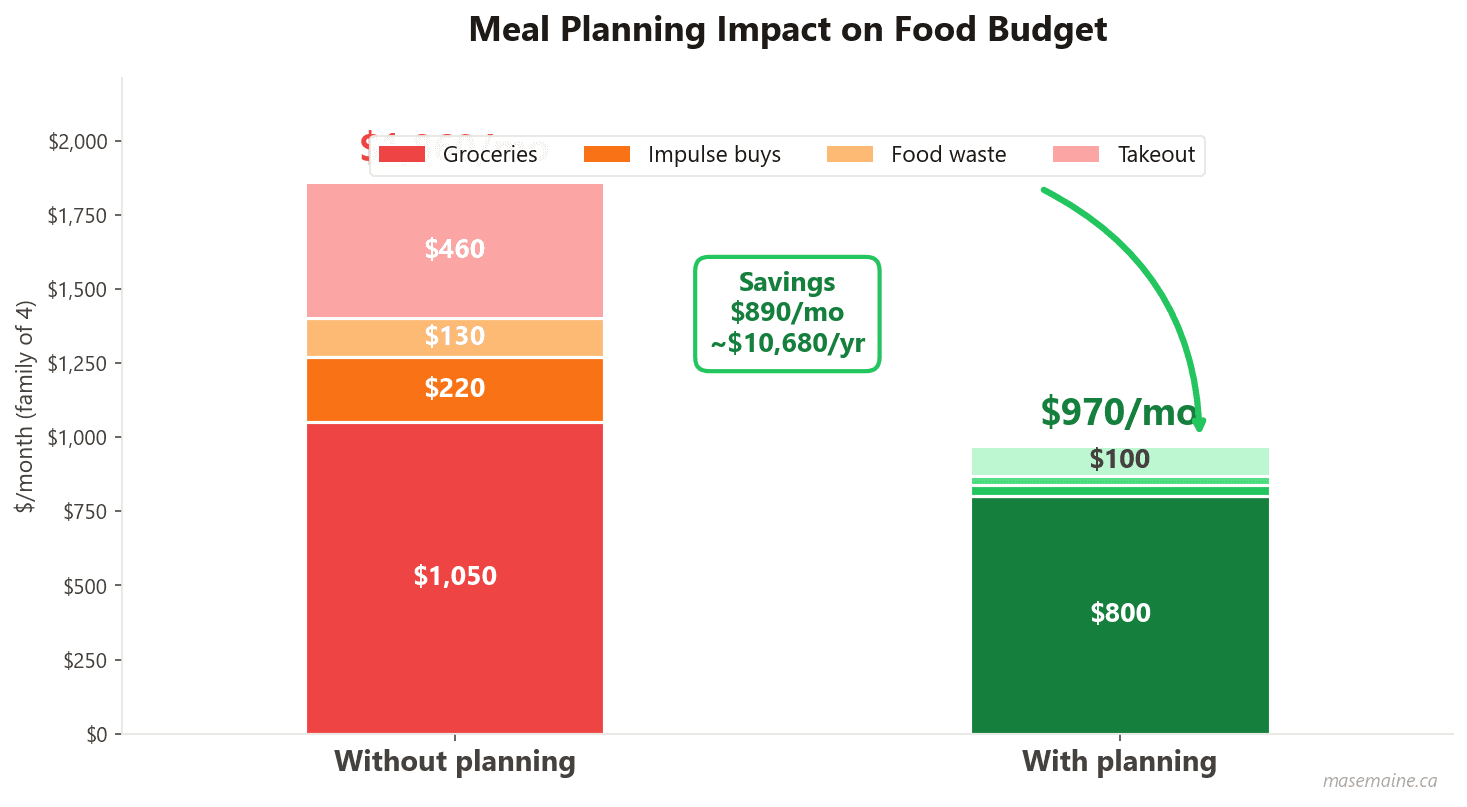
Before we get into the steps, let's look at what "winging it" actually costs. Here's what a typical family of four spends when they shop without a plan versus with one:
The difference is $4,000–$8,000 per year. That's not a rounding error — it's a vacation, a car payment, or a year of after-school activities.
The savings come from three things: buying only what you need, buying it when it's on sale, and actually cooking what you bought so nothing gets wasted.
Here's how to do it, step by step.
Step 1: Check what you already have
Time: 5 minutes. Savings: $15–$30/week.
Open your fridge, freezer, and pantry. Look for proteins that need to be used soon, vegetables that are about to turn, and staples you still have plenty of.
This step prevents the two most expensive mistakes in grocery shopping:
- Buying duplicates. Most households have $50–$100 worth of forgotten food at any given time — half-used bags of rice, cans pushed to the back of the cupboard, frozen meat from three weeks ago.
- Letting food go to waste. The National Zero Waste Council estimates Canadian families throw away $1,100–$1,500 of food per year. Checking first means you build meals around what's already there.
Write a quick list: "Need to use: ground beef (freezer), spinach (fridge), half a bag of rice." These items become the starting point for your meal plan.
Step 2: Check the flyers
Time: 5–10 minutes. Savings: $30–$60/week.
This is the single most impactful step. Every week, Maxi, Metro, IGA, Super C, Provigo, and Walmart publish flyers with loss leaders — deep discounts designed to get you into the store. Your job is to let those deals shape your menu.
What to look for:
- Proteins on sale. Chicken thighs at $3.99/kg instead of the regular $8.99/kg. Ground beef at $10.76/kg instead of $19.82/kg. Pork loin at $4.39/kg.
- Produce in season. In-season fruits and vegetables are often 40–60% cheaper than out-of-season imports.
- Pantry staples. Pasta, canned tomatoes, rice, and cooking oils cycle through sales every 4–6 weeks.
The key insight: plan your meals around what's cheap this week, not the other way around. If you decide you want beef stroganoff and then go buy full-price beef, you've already lost. If you see beef on sale and then decide on stroganoff, you win.
Step 3: Pick 5–7 meals for the week
Time: 10–15 minutes. Savings: prevents the $50–$100/week takeout trap.
You don't need to plan every single meal. Breakfasts and lunches can be simple rotations (oatmeal, eggs, sandwiches, leftovers). The critical thing is to plan dinners — because dinner is where the expensive decisions happen. An unplanned Tuesday night turns into $45 of Uber Eats faster than you think.
Rules that keep it simple:
- Plan 5 dinners, not 7. Leave room for leftovers and flexibility. Planning every single meal creates pressure that makes the whole system collapse.
- Use the proteins from step 2. If chicken thighs are $3.99/kg at Maxi and ground pork is on sale at Super C, build your week around those.
- Repeat what works. You don't need five unique gourmet meals. A rotation of 15–20 reliable recipes covers you for a month without repeating a single week.
- Account for busy nights. If Wednesday is hectic, plan something that takes 20 minutes or uses leftovers.
Example week built around sales:
Step 4: Make a precise grocery list
Time: 10 minutes. Savings: $25–$50/week in avoided impulse buys.
Go through each planned meal. Write down exactly what you need and in what quantity. Cross off anything you already have from step 1.
The word "precise" is doing real work here. The difference between "buy chicken" and "buy 1.5 kg chicken thighs" is the difference between spending $12 and spending $25. Vague lists lead to overbuying.
Organize your list by store section (produce, meat, dairy, pantry) so you move through the store efficiently and don't wander into aisles where impulse purchases live.
Step 5: Shop with discipline
Time: 30–45 minutes. Savings: $20–$40/week in avoided extras.
You have a list. Stick to it. This sounds trivial, but grocery stores spend millions on layout and placement designed to make you buy things you didn't plan for. End-cap displays, checkout candy, "2 for $5" deals on things you don't need — it adds up.
Practical tips:
- Shop after eating, not when you're hungry. Hungry shoppers spend 15–20% more on average.
- Set a timer. The longer you're in the store, the more you spend. In and out in 30–40 minutes is the goal.
- Skip the inner aisles unless something on your list is there. The perimeter (produce, meat, dairy) is where the real food lives.
- Compare unit prices, not package prices. A $4.99 bag of rice might be cheaper per kilogram than a $3.49 bag.
- Choose the right store. You don't have to do all your shopping in one place. Many planners buy loss leaders at Maxi or Super C and fill in specialty items at IGA or Metro.
One trip, one list, no browsing. That's the discipline that protects your budget.
Step 6: Prep what you can
Time: 1–2 hours on Sunday. Savings: prevents 2–3 takeout orders/week ($80–$150).
This isn't about becoming a meal-prep influencer with 42 matching containers. It's about removing the friction that causes the plan to fail mid-week.
At minimum:
- Wash and chop vegetables for the first 2–3 days of meals.
- Marinate proteins that need it (takes 5 minutes, saves 30 minutes on a weeknight).
- Cook grains in bulk. A big pot of rice or quinoa lasts 3–4 days and makes weeknight cooking 15 minutes faster.
- Double one recipe and freeze half. Future you will thank present you on that Thursday when nothing sounds appealing.
The financial impact of prep is indirect but massive. Every time you open the fridge and see something ready to cook in 20 minutes, you avoid a $40–$60 takeout order. Over a month, that's $160–$300 saved.
Step 7: Track your spending
Time: 5 minutes/week. Savings: awareness creates accountability.
Keep a simple log of your weekly grocery spending. It doesn't need to be fancy — a note on your phone, a spreadsheet, whatever works. The point is to see the trend over time.
Most families who start meal planning see a drop in the first two weeks, a small rebound in week three (when old habits creep back in), and then a steady decline as the system becomes routine.
After a month, compare your total to what you were spending before. If you're saving $150–$300/month, you're right on track. If not, look at where the leaks are — usually it's impulse purchases, forgotten leftovers, or too many takeout exceptions.
Common obstacles (and how to handle them)
"I don't have time to plan." The full process above takes 30–40 minutes once a week. Compare that to the time you spend every evening standing in front of the fridge, arguing about what to eat, driving to pick up takeout, or making an extra grocery run because you forgot something. Planning saves time — it just moves it to a single block instead of spreading it across seven stressful evenings.
"My family is picky." Start with meals everyone already likes. You're not changing what you eat — you're changing when you decide what to eat. If your kids eat pasta, chicken, and rice, great. Plan those meals intentionally around the sales instead of buying them at full price on Tuesday night.
"I don't know enough recipes." You need 15–20 reliable dinners to rotate through a full month without repeats. Most families already have 8–10 go-to meals. Add one new recipe per week and within two months you'll have a complete rotation.
"The deals are at different stores and I don't want to shop at three places." Pick one main store and one deal store. Do 80% of your shopping at whichever has the best overall prices (Maxi and Super C tend to win on staples) and make one quick stop for specific loss leaders elsewhere. Two stores, two stops, still under an hour total.
The compounding effect
Meal planning is not a one-time trick. It's a system that compounds. In the first week, you might save $30. By the fourth week, you've learned what sells when, you have a growing recipe rotation, and your freezer has backup meals. By month three, the savings hit $200–$400/month consistently because every part of the system reinforces the others:
This is why families who stick with meal planning for three months almost never go back.
Frequently Asked Questions
How much money can you really save by meal planning? Most families save $200–$400/month, or $2,400–$4,800/year. The biggest savings come from three areas: reduced impulse purchases ($25–$50/week), buying proteins on sale instead of at full price ($15–$30/week), and fewer takeout orders ($40–$100/week). Your results depend on how much you currently spend and how consistently you follow the plan.
How long does meal planning take each week? The full process — checking your fridge, reviewing flyers, choosing meals, and writing a grocery list — takes 30–40 minutes. With practice, it drops to about 20 minutes. Compare that to the cumulative time spent each week deciding what to eat, making extra trips to the store, and waiting for delivery.
What if I don't know how to cook many recipes? Start with what you know. Even planning five simple meals you already make (pasta, stir-fry, tacos, soup, sheet-pan chicken) saves money because you're buying intentionally instead of reactively. Add one new recipe per week and you'll have a solid rotation within two months.
Is it worth shopping at multiple stores for deals? It can be, but don't overdo it. Driving to four stores wastes gas and time. The sweet spot is one main store (like Maxi or Super C for everyday staples) plus one quick stop at another store for specific loss-leader deals. Many families find that checking flyers and shopping at two stores saves them $40–$60/week compared to shopping at one store without checking deals at all.
How do I keep the plan from falling apart mid-week? Two things: leave flexibility (plan 5 dinners, not 7) and always keep a backup meal in the freezer. Plans fail when there's zero margin. If Wednesday hits and you have no energy to cook, Monday's leftovers or a frozen soup protects your budget — that's a $40–$60 takeout order avoided.
Do I need meal prep containers to get started? No. Meal prep doesn't require special equipment. Glass or plastic containers you already own, freezer bags, and aluminum foil are enough. What matters is the preparation (washing, chopping, marinating), not matching containers. Families who spend $80 on containers before starting put unnecessary pressure on themselves.
Does meal planning work for one person? Absolutely. Per-person savings are often even bigger because package sizes in Quebec are designed for families. A single person who buys a 4-pack of chicken breasts on sale can freeze 3 and have protein for 2 weeks. Food waste hits single-person households harder — Statistics Canada estimates that people living alone throw away proportionally more food than families.
How to Actually Do This Every Week (Without Willpower)
The seven steps work. But if you're honest, it's still 30–40 minutes of work each week — and that's where most people quit. MaSemaine automates steps 1–6 so all you have to do is pick what sounds good.
Step 1 — Your preferences, not prescriptions:
You pick what your family likes to eat. Nobody forces you to eat lentils.
Step 2 — Deals matched automatically:
When chicken thighs are $3.99/kg at Maxi instead of $8.99 at Metro, your recipes adjust automatically.
Step 3 — A grocery list with the best prices:
No more wandering the aisles. A precise list organized by section, with prices compared across stores.
References
- National Zero Waste Council. (2020). A Food Loss and Waste Strategy for Canada. — Canadian households throw away approximately $1,100–$1,500 worth of food per year.
- Tal, A., & Wansink, B. (2013). Fattening fasting: Hungry grocery shoppers buy more calories, not more food. JAMA Internal Medicine, 173(12), 1146–1148. doi:10.1001/jamainternmed.2013.650 — Hungry shoppers buy 15–20% more calories.
- Statistics Canada. (2022). Canadian Social Survey: Food Security. Catalogue no. 13-25-X. — Average household food expenditures and proportional waste by household size.
- Ducrot, P., et al. (2017). Meal planning is associated with food variety, diet quality and body weight status in a large sample of French adults. International Journal of Behavioral Nutrition and Physical Activity, 14(1), 12. doi:10.1186/s12966-017-0461-7 — Meal planning is associated with better diet quality and healthier body weight.
Read more: